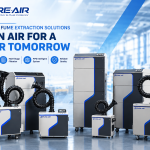
Industrial processing environments release complex mixtures of solid dust, aerosol droplets, and gaseous vapors that require distinct separation mechanisms. High-Efficiency Particulate Air (HEPA) filters capture solid particles through a dense mat of randomly arranged glass microfibers. Selecting an effective industrial HEPA air purifier requires understanding how physical mechanics isolate sub-micron solid particles from flowing air.

Physical Filtration Mechanics: Three Core HEPA Capture Principles
HEPA filter media consists of dense, randomly stacked glass fiber meshes that physically block airborne solid contaminants through three complementary mechanical mechanisms, enabling stable interception of micron and sub-micron particles. Inertial impaction acts on large, heavy particles above 1–2 μm. Due to mass inertia, these particles cannot follow airflow streamlines and collide directly with filter fibers, achieving stable deposition.
Interception applies to medium-sized particles. When particle trajectories approach fiber surfaces within their own radius range, particles adhere to the fibers without relying on inertial collision. Diffusion capture dominates for ultra-fine submicron particles below 0.3 μm. Brownian motion increases particle wandering distance, raising the probability of contact and adhesion with fiber structures. This triple-mechanism collaboration enables H14-grade HEPA media to achieve ultra-high efficiency filtration for full-spectrum solid dust.
Chemical Adsorption Principles of Activated Carbon Filtration
While mechanical filters trap solid particulate matter, gaseous chemical molecules pass directly through physical fiber webs. Activated carbon media utilizes porous carbon structures treated to expand internal surface areas significantly. Trapping gas-phase contaminants relies on physical adsorption, where chemical molecules adhere to internal pore walls through Van der Waals forces.
Microscopic pores within activated carbon beds accommodate volatile organic compounds, solvent vapors, and pungent chemical odors. Impregnating carbon media with specialized chemical reagents allows activated carbon to neutralize specific acidic or alkaline gases through chemisorption. Combining mechanical filtration with carbon beds addresses both solid and gas-phase emissions.
Categorizing Target Pollutants Across Industrial Applications
Distinguishing between particulate pollutants and gas-phase emissions determines which filtration media is required for specific processing tasks. Mechanical cutting, grinding, and metal processing generate solid metallic dust, ceramic particles, and smoke condensates. These solid airborne pollutants require high-efficiency mechanical filtration to keep breathing zones clean.
Conversely, chemical coating, laser processing, and solvent cleaning generate volatile organic compounds, ozone, and gaseous byproduct emissions. While specialized ozone air purifiers manage gas-phase oxidation and chemical degradation, mechanical filters alone cannot neutralize these gaseous compounds. Correctly identifying target pollutants prevents installing inappropriate filtration media.
Synergy of Multi-Stage Combination Filtration Frameworks
Industrial processing lines rarely produce solid dust or purely gaseous contaminants in isolation. Heavy thermal cutting and welding processes generate both sub-micron metallic oxide particles and volatile organic gas mixtures simultaneously. Utilizing a single filtration stage causes rapid filter blinding or allows gaseous contaminants to bypass extraction systems completely.
Combining pre-filters, HEPA cartridges, and activated carbon modules into a multi-stage system optimizes overall air purification performance. Primary pre-filters trap coarse dust to extend the service life of expensive downstream HEPA elements. At PURE-AIR, we design multi-stage filtration layouts that address both solid particles and volatile gases efficiently.
Practical System Selection and Sizing Guidelines
Configuring air purification hardware requires evaluating process parameters including airflow volume, static pressure, substrate composition, and operating hours. Processing high-density metallic alloys demands high static pressure blowers coupled with e-PTFE or HEPA filter cartridges. Laser processing on acrylic or vinyl substrates mandates heavy carbon beds to absorb volatile monomers and acid gases.
Selecting appropriate equipment configurations helps prevent premature filter clogging and protects internal blower motors from excessive strain. Integrating dedicated brushless fans developed in-house supports long-term operational performance under varying static pressure loads. Equipment setups like our PA-D1600 and PA-FS800 models offer tailored multi-stage filtration for demanding industrial environments.
Engineering Standards for Continuous Industrial Air Purification
Sustaining continuous air purification across 14 years of industrial R&D requires robust hardware construction and self-developed core components. Our engineering team at PURE-AIR designs custom brushless motors and control platforms to power multi-stage filtration hardware. Holding over 50 patents enables us to advance industrial VOC removal standards across global manufacturing operations.
Reliable core components maintain stable airflow and pressure balances across 30 distinct industrial sectors. Protecting over 100,000 workers while reducing tons of industrial emissions yearly reflects our commitment to eco-friendly air handling solutions. Deploying durable hardware helps manufacturing facilities maintain clean indoor air across 70 countries worldwide.
Specialized Gas Abatement Protocols for Reactive Process Gases
Handling reactive gases like ozone, hydrogen chloride, or monomer vapors requires specialized filtration media beyond standard mechanical filters. Catalytic filtration modules break down ambient ozone molecules into oxygen, preventing corrosive oxidation inside exhaust channels. Utilizing specialized ozone air purifiers protects internal machinery while maintaining workplace air safety.
Customized chemical adsorption beds incorporate impregnated carbon to neutralize aggressive acid gases safely. Systems like our D-i Series offer flexible modular options to accommodate specialized chemical gas abatement protocols. Tailoring chemical filtration media prevents hazardous gaseous compounds from recirculating back into plant breathing zones.
Conclusion
Distinguishing between physical particulate capture and chemical gas adsorption is critical for building effective industrial air purification strategies. Deploying an industrial HEPA air purifier equipped with multi-stage HEPA filters and activated carbon modules captures sub-micron metal oxides and absorbs volatile chemical vapors simultaneously. Through self-developed core components and continuous innovation at PURE-AIR, industrial facilities maintain safe, compliant, and efficient production environments across diverse manufacturing applications.