Metal processing generates pollutants spanning a wide particle size spectrum, which directly determines the matching design and operational performance of dust extraction equipment. Coarse grinding debris and flaking coating residues are particles larger than 10 microns with high specific gravity, which settle rapidly under natural gravity and can be intercepted with basic primary dust removal structures.
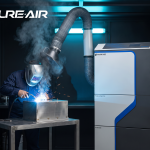
In contrast, thermal welding and metal fusion processes vaporize metal materials under intense heat to form ultra-fine metal oxide aerosols smaller than 1 micron; these tiny particles cannot be settled by gravity alone and become the core difficult pollutant for welding fume collector to govern.
Sub-micron particulates remain suspended in air currents persistently, drifting across production floors rather than falling into drop-out hoppers. High thermal energy during arc operations vaporizes metal alloys, forming aerosolized condensates that easily bypass coarse filter meshes.

Physical Differences in Filter Media Capabilities
Standard cellulose filter cartridges perform well when capturing coarse shop dust through simple mechanical impaction. However, porous cellulose fibers allow ultra-fine thermal smoke to pass through internal channels largely unhindered. Effective automotive manufacturing welding fume extraction demands specialized synthetic filter media with tighter pore structures.
Adding expanded polytetrafluoroethylene (e-PTFE) membranes to synthetic media creates a microscopic barrier on the filter surface. Surface filtration minimizes fine particles from penetrating deep into the media matrix, allowing automatic compressed air pulses to clear accumulated dust efficiently. Membrane-coated media prevents deep depth loading and helps keep pressure drops stable.
Comparing MERV Ratings and HEPA Filtration Standards
Filter performance ratings reflect a media’s ability to trap specific particle size ranges under standard test conditions. Standard MERV 11 to 15 filters capture medium-to-large particulates but struggle with sub-micron thermal fumes. Fine metal oxide particulates require MERV 16 or HEPA H14 media to achieve effective collection efficiency.
HEPA H14 filtration retains sub-micron contaminants down to 0.3 microns with 99.99% efficiency, capturing harmful hexavalent chromium and zinc oxides. Utilizing a multi-stage welding fume collector equipped with HEPA filtration keeps fine particulate matter from recirculating back into workplace breathing zones. High-efficiency media selection provides predictable air quality across demanding metal join bays.
Operational Limitations of Conventional Dust Collectors
Traditional woodworking or metal grinding dust collectors rely on high volumetric airflow at low static pressure. While high air volumes move heavy surface dust effectively, low negative static pressure fails to pull dense smoke through long duct runs or tight capture hoods. Thermal smoke escapes low-pressure hoods, spreading volatile gases throughout factory bays.
Choking airflow causes sub-micron particulates to settle inside duct channels or bypass primary filter bags entirely. Proper thermal extraction requires high negative static pressure blowers that maintain transport velocity across complex duct configurations. Specialized equipment lines like our PA-FS800 series utilize high static pressure blowers up to 8000 Pa to manage dense smoke streams.
Multi-Stage Filtration Architecture for Mixed Process Lines
Facilities operating coating, polishing, and joining lines simultaneously face complex multi-contaminant streams. Coarse coating dust blinds fine HEPA filters rapidly if loaded together on a single filter stage. Integrating spark traps, pre-filters, e-PTFE cartridges, and final HEPA stages protects downstream elements from premature clogging.
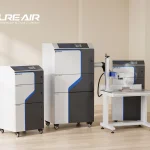
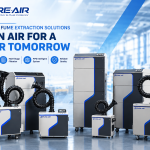
Sequencing filter media ensures each layer targets its corresponding particle size range efficiently. Units like our PA-FS400 and PA-FS1600 models utilize multi-stage filtration to capture heavy grinding dust while polishing fine smoke before exhaust discharge.
Strategic System Upgrade Recommendations for Metal Fabrication Facilities
Upgrading legacy ventilation systems requires evaluating fan static pressure, duct velocity, and filter media specifications. Facilities replacing basic baghouses with high-efficiency cartridge systems improve sub-micron particle capture without increasing total energy consumption. Installing automated differential pressure sensors helps maintenance teams track filter loading accurately.
Upgrading duct layouts with smooth transitions and sealed connections helps prevent static pressure losses before air reaches collection cabinets. Incorporating compact equipment like our C-50 and PA-FS300 models at isolated work cells provides dedicated high-pressure extraction. At PURE-AIR, we assist plants in retrofitting existing ventilation layouts to capture fine smoke effectively.
Automated Filter Cleaning Mechanisms and System Longevity
Accumulated sub-micron dust increases internal static pressure, reducing suction velocity at collection hoods over time. Integrated pulse-jet cleaning systems fire short bursts of compressed air through filter cartridges to dislodge surface dust cakes. Self-cleaning mechanisms keep filter pores open without interrupting active manufacturing schedules.
Regular automated pulse cleaning extends total filter element service life and maintains consistent capture velocity at work hoods. Combining e-PTFE media coatings with pulse-jet cleaning prevents fine particles from embedding deep within filter substrates. Effective self-cleaning reduces manual maintenance frequency and supports continuous 24/7 shop operations.
Advanced Environmental Control Across Automated Production Lines
High-throughput vehicle manufacturing lines require integrated extraction systems that match robotic cycle times. Automated production cells handling welding, 3D printing, and metal finishing generate dynamic particulate loads requiring variable blower speeds. Intelligent controllers adjust fan frequencies dynamically based on real-time static pressure sensors.
Connecting extraction hardware to central plant monitoring platforms gives maintenance engineers full visibility into system performance metrics. Continuous monitoring helps prevent sudden airflow drops during critical joining cycles. Deploying engineered extraction hardware supports compliant automotive manufacturing welding fume extraction while maintaining clean production environments.
Technical Conclusion: Particle-Graded Purification System Design Logic
The full-spectrum particle distribution formed during high-temperature metal joining determines the complete technical path for flue gas treatment: graded interception according to particle size, high-static-pressure air supply to lock in flue gas capture efficiency, and modular multi-stage filter layout to protect high-precision terminal filter materials.
PURE-AIR delivers full-cycle technical support including on-site particle condition detection, ventilation pipeline resistance calculation, staged filter configuration design and old smoke exhaust system renovation scheme demonstration. Our engineering team customizes particle-adaptive extraction systems to match actual production working conditions for automotive and metal processing workshops.