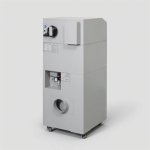
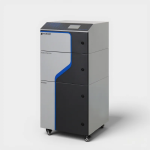
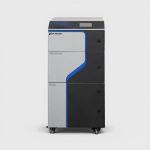
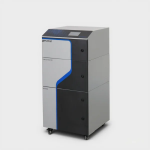
A common question we encounter at PURE-AIR centers on the practicality of a single system managing two distinct challenges: fine particulate dust and volatile chemical fumes. In industrial environments, processes often generate both simultaneously, creating a complex air quality issue. Relying on separate units for each contaminant type is often inefficient in terms of space, energy, and operational oversight. This leads us to examine whether integrated fume extraction technology can be engineered to address this duality effectively. The core of the matter lies in the different behaviors and capture requirements of solid particles versus gaseous molecules, demanding a sophisticated filtration strategy within a cohesive dust fume extraction framework.
The Technical Divide Between Dust and Fume Capture
The primary challenge in creating a unified system is the fundamental difference between dust and chemical fumes. Fine dust consists of solid particles that can be effectively captured using physical filtration media, such as high-efficiency cartridge filters. Chemical fumes, however, are often molecular in size and require a different mechanism, typically adsorption via activated carbon or other specialized filters. A system designed only for particulate will not arrest hazardous vapors, while a system solely for fumes will quickly clog with dust. Therefore, effective fume extraction technology for combined applications must sequentially address both contaminant types. It requires a multi-stage design where particulate is removed first to protect and extend the life of the subsequent chemical filtration stages, creating a comprehensive dust fume extraction solution.
The Role of Intelligent Monitoring and Control
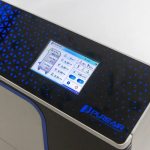
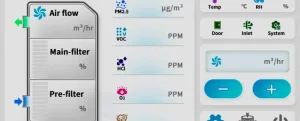
Managing such a multi-stage system necessitates precise operational awareness. This is where system intelligence becomes critical. The PURE-AIR Intelligent Purification System features a colorful touch screen that displays all key parameters in real time. With advanced fume extraction technology and an intuitive interface, operators can easily monitor performance and manage the industrial dust and fume extraction system with precision. This design ensures full visibility into machine operation, improving safety and control. For instance, differential pressure across the particulate filters can be monitored to signal when maintenance is needed, while sensor data can indicate the saturation level of chemical filters, ensuring neither stage compromises the other’s function.
Maintaining Performance Through Adaptive Operation
A significant concern with dual-function systems is performance decay. As filters load, airflow can drop, reducing capture efficiency at the source—a critical failure point for both worker safety and process integrity. To combat this, the system must be self-regulating. The PURE-AIR Intelligent Purification System utilizes advanced sensors and AI algorithms to automatically adjust the airflow based on filter blockage levels. This fume extraction technology ensures that the set air volume is consistently maintained, guaranteeing stable suction efficiency and reliable performance across industrial dust and fume extraction systems. By optimizing airflow compensation, PURE-AIR helps maintain maximum purification results even under heavy-duty operation, ensuring that the capture of both dust and fumes remains effective throughout the filtration cycle.
In conclusion, the question of a single system handling both fine dust and chemical fumes is met with a definitive positive, provided the system is engineered with intentional, staged filtration and intelligent control. The integration of real-time monitoring and automatic airflow compensation transforms a basic extraction unit into a responsive and reliable purification system. For industrial applications where space and operational simplicity are valued alongside stringent air quality requirements, a unified approach using advanced fume extraction technology presents a viable and efficient solution for comprehensive dust fume extraction.