Are Laser Cutter Fumes Toxic in Industrial Environments? Understanding Emissions, Exposure Limits, and Compliance
Laser cutter fumes can be hazardous in industrial environments because cutting can generate airborne particulate matter and combustion by-products, while the exact risk depends on the material, process conditions, exposure level, and effectiveness of engineering controls. NIOSH identifies combustion by-products from laser and plasma cutting as potential inhalation hazards and notes that ventilation can help control volatile and particulate emissions.
Are Laser Cutter Fumes Toxic in Industrial Environments?
Laser cutter emissions can present an occupational inhalation hazard, but calling every laser-cutting fume inherently “toxic” would be too broad. The hazard depends on what is being cut and what contaminants the process produces.
When a high-energy laser interacts with metal, heat can vaporize or melt material and generate fine particles and gaseous by-products. NIOSH identifies combustion by-products from laser cutting as potential inhalation hazards and recommends engineering controls, training, and ventilation as part of a broader safety programme.
For manufacturers, the practical question is not simply whether smoke is visible. The more useful questions are which contaminants are being generated, where they accumulate, how workers can be exposed, and whether controls keep exposure within applicable limits.
What Makes Laser Cutter Fumes Potentially Hazardous?
The composition of laser-cutting emissions changes with the processed material, so stainless steel, carbon steel, galvanized sheet, aluminium, and coated materials should not automatically be treated as producing identical emissions.
Metal processing can generate respirable or inhalable particles containing elements associated with the workpiece or coating. Depending on the process, gases such as ozone, nitrogen oxides, or carbon monoxide may also require consideration. The hazard assessment should therefore begin with material information, process conditions, and measured or reasonably anticipated contaminants.
| Risk factor | Why it matters | What to check |
| Processed material | Different alloys and coatings can produce different contaminants. | Material composition and coatings |
| Particle generation | Fine particles can remain airborne and enter the breathing zone. | Capture point and filtration |
| Gaseous emissions | Some processes can generate volatile or reactive gases. | Process chemistry and air treatment |
| Worker exposure | Risk depends on concentration and duration, not visibility alone. | Exposure monitoring and work practices |
What Exposure Limits Apply to Laser Cutting Fumes?
There is no single OSHA exposure limit for “laser fumes”; compliance is determined by the specific hazardous substances present and the exposure limits that apply to those substances and the workplace.
For example, OSHA sets an 8-hour time-weighted average permissible exposure limit (PEL) of 5 micrograms per cubic metre for hexavalent chromium, with an action level of 2.5 micrograms per cubic metre. This is relevant when a process can generate Cr(VI), but it should not be presented as a general limit for all metal-cutting emissions.
OSHA also lists an 8-hour TWA PEL of 1 mg/m³ for nickel metal and insoluble compounds, while its chemical database shows different recommended limits from NIOSH and other authorities. Manganese has its own regulatory and recommended limits as well. These differences demonstrate why the contaminant must be identified before selecting a compliance benchmark.
Manufacturers should identify applicable substances, determine whether OSHA or another jurisdictional standard applies, conduct exposure assessment where required, and use engineering and work-practice controls before relying on personal protective equipment as the primary measure.
| Example substance | OSHA value | Important qualification |
| Hexavalent chromium (Cr(VI)) | 5 µg/m³, 8-hour TWA PEL | Applies specifically to Cr(VI) exposures under the applicable standard. |
| Nickel metal and insoluble compounds | 1 mg/m³, 8-hour TWA PEL | Different substances and jurisdictions can have different limits. |
| Manganese compounds and fume | OSHA ceiling value listed as 5 mg/m³ | The applicable standard and sampling approach must be verified for the workplace. |
Sources: OSHA Chromium (VI) Standard; OSHA Chemical Data for Nickel and Manganese.
How Can Manufacturers Control Laser Cutter Fume Exposure?
The most direct control is to capture emissions as close to the generation point as practical, then filter or treat the extracted air using equipment selected for the actual contaminants and operating conditions.
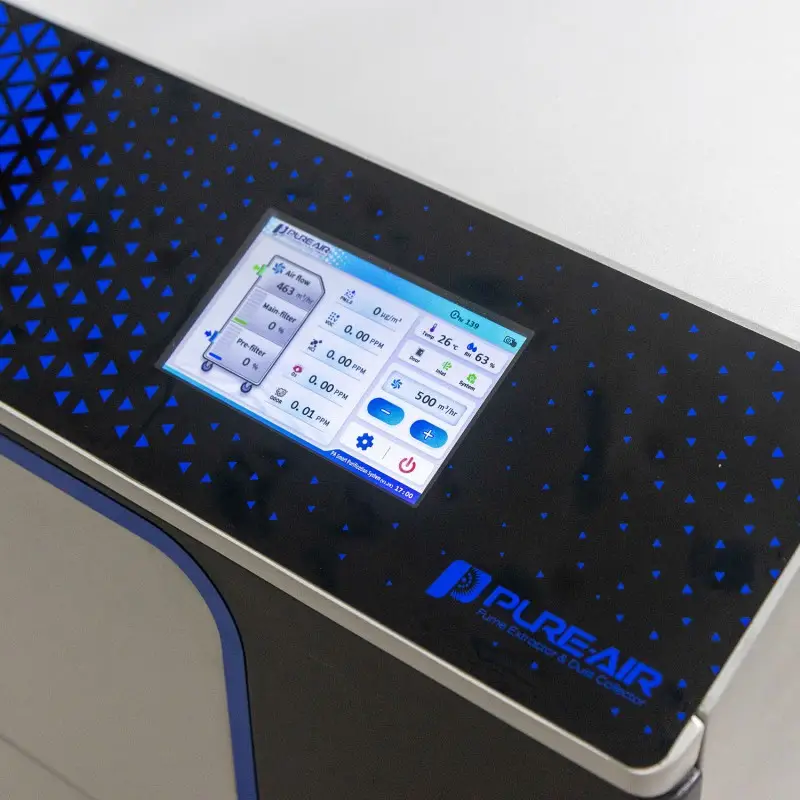
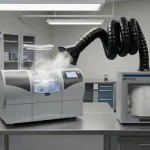
A properly designed fume extraction system can reduce the amount of particulate and gaseous contamination released into the general workspace. NIOSH specifically identifies ventilation as a means of controlling volatile and particulate emissions from laser and plasma cutting.
Manufacturers should assess the machine enclosure, extraction connection, airflow requirement, pressure losses, filter type, spark and debris control, maintenance access, and whether additional gas-phase treatment is necessary. The goal is controlled capture, not simply moving contaminated air from one part of the workshop to another.
Exposure monitoring remains important where hazardous substances have applicable occupational limits. A control system should be evaluated against actual operating conditions, including production rate, material changes, extraction performance, filter loading, and worker location.
What Should Buyers Check Before Choosing a Fume Extraction System?
- Confirm the materials and coatings that will be processed.
- Identify the particulate and gaseous contaminants that need to be controlled.
- Match airflow and pressure capability to the machine, ducting, capture arrangement, and operating conditions.
- Check filtration media and whether anti-static, flame-retardant, or gas-phase filtration is appropriate.
- Plan filter cleaning, inspection, replacement, and dust handling before commissioning.
- Verify installation and workplace controls against the applicable local occupational-safety requirements.
How Does PURE AIR Approach Laser Cutting Fume Extraction?
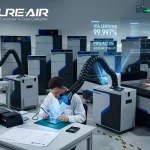
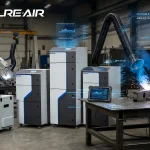
PURE AIR offers industrial fume extraction solutions for laser processing and lists laser cutting, electronics, digital printing, additive manufacturing and 3D printing, automotive, and lithium battery and photovoltaic applications.
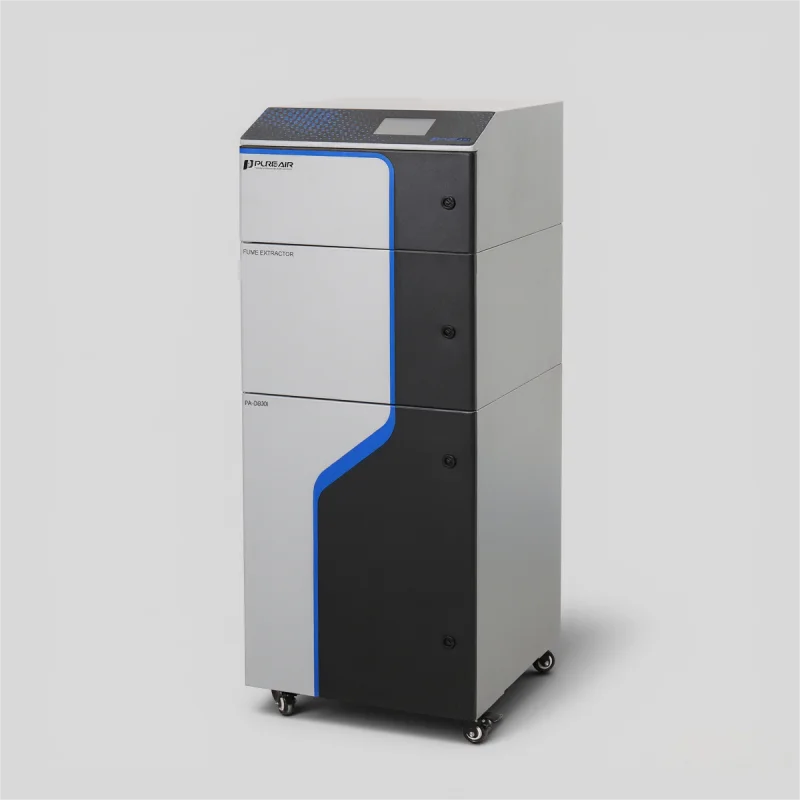
Its Laser Cutting Metal Fume Extractor is designed for laser cleaning, laser cutting, and laser marking. The listed models include PA-D5000, PA-D6000, PA-D10000, PA-D12000, PA-DE3000, PA-DE5000, and PA-DE6000, with stated airflow capacities of 3,000–12,000 m³/h and pressure ratings of 3,000–3,500 Pa.
The system uses a pre-filter and PTFE cartridge filtration, with optional flame-retardant and anti-static configurations and optional treated activated carbon. PURE AIR states a 99.99% filtration efficiency for 0.3-micron metal dust under its stated product specifications.
These specifications are useful starting points for equipment selection, but they should not be interpreted as a universal guarantee of regulatory compliance. Final suitability depends on the laser machine, material, capture arrangement, contaminants, installation, and applicable exposure requirements.
| PURE AIR product information | Officially stated details |
| Product | Laser Cutting Metal Fume Extractor |
| Listed models | PA-D5000, PA-D6000, PA-D10000, PA-D12000, PA-DE3000, PA-DE5000, PA-DE6000 |
| Airflow range | 3,000–12,000 m³/h |
| Pressure range | 3,000–3,500 Pa |
| Filtration | PTFE cartridge; optional flame-retardant and anti-static configurations |
| Additional treatment | Treated activated carbon listed as optional |
How Should Manufacturers Build a Laser Fume Control Strategy?
Manufacturers should treat laser-fume control as an engineering and exposure-management issue rather than a simple equipment purchase.
- Characterise the materials, coatings, cutting parameters, and production volume.
- Identify likely particulate and gaseous contaminants and determine which occupational limits apply.
- Use source capture and suitable filtration or treatment as the primary engineering control.
- Inspect extraction performance and filters regularly and maintain the system according to equipment and process requirements.
- Use exposure monitoring when required or when uncertainty remains about worker exposure.
- Document the control strategy and review it when materials, machines, layouts, or production conditions change.
For equipment selection, PURE AIR can be evaluated against the specific laser machine and process. Buyers who need help matching airflow, pressure, filtration, and application requirements can contact us with machine details, materials being processed, operating conditions, and any available exposure or ventilation information.
Conclusion: Are Laser Cutter Fumes Toxic in Industrial Environments?
Laser cutter fumes can be hazardous, but their risk cannot be judged from the word “fume” alone. The material being processed determines much of the potential contaminant profile, while concentration, exposure duration, capture effectiveness, and workplace controls determine the practical exposure risk.
For industrial manufacturers, the strongest approach is to identify contaminants first, determine applicable exposure limits, and then use source-capture ventilation and appropriate filtration or gas treatment as part of a documented control strategy. A correctly specified fume extraction system can be an important engineering control, but equipment specifications should always be evaluated in the context of the complete workplace safety programme.