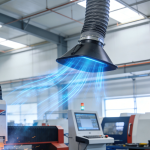
In the field of industrial fume purification, equipment managers have long been troubled by two core questions: “Is the suction power consistently effective?” and “When exactly should the filter be replaced?” Traditional practices rely on empirical judgment or fixed replacement schedules—often resulting in either compromised safety due to performance degradation or excessive waste of filter media.
As an industrial fume purification expert with 14 years of in-house R&D and manufacturing experience, PURE-AIR understands that true reliability stems from real-time awareness and precise management of the equipment’s core status. Through our self-developed “PIPS Intelligent Purification System,” we have turned this philosophy into reality, advancing equipment management from vague empiricism into an era driven by precise data.
I. Suction Performance Monitoring: Beyond “Airflow” to “Effective Power”
Suction performance (negative pressure and air volume) is the fundamental guarantee of purification effectiveness. PURE-AIR’s monitoring solution goes beyond simple fan operation checks, establishing a multi-dimensional performance health system:
Real-Time Core Parameter Monitoring:
High-Precision Sensors: High-accuracy negative pressure and airflow sensors are integrated at key points in the equipment’s air path, collecting data 24/7.
Dynamic Baseline Comparison: The PIPS system establishes an initial performance baseline curve for each unit with clean filters. During operation, it continuously compares real-time data against this dynamic baseline, rather than using static threshold judgments.
Intelligent Diagnosis of Performance Degradation:
When real-time negative pressure or airflow deviates beyond the set range from the baseline, the system does more than just trigger an alarm; it initiates an intelligent diagnostic process:For gradual performance decline caused by filter clogging, it links to the filter life management module.
For sudden performance changes due to duct leaks, inlet blockages, or fan abnormalities, the system immediately identifies the problematic zone and provides clear prompts on the interface, such as “Main arm duct may be detached” or “Dust hood inlet blockage risk,” guiding maintenance personnel to troubleshoot quickly and accurately.
II. Filter Life Monitoring: Moving from “Time-Based” to “Efficiency-Based”
The filter is the heart of the purification unit, and its condition directly determines emission safety and operational costs. PURE-AIR abandons fixed time-based replacement in favor of a triple-fused “efficiency-based” life monitoring strategy:
First Layer: Core Parameter Direct Monitoring – Differential Pressure Sensing
Differential pressure sensors are installed before and after the filter. As the filter loads with contaminants, airflow resistance increases, causing a steady rise in the pressure differential across it. The PIPS system continuously tracks this pressure differential curve. When it reaches the preset maximum final resistance (indicating the filter is fully loaded—continued use would severely sacrifice airflow and increase energy consumption), the system issues a replacement warning.Second Layer: Usage Load Accumulation Calculation – Equivalent Operating Hours
The system doesn’t just track time; it calculates “Equivalent Operating Hours.” It dynamically adjusts the filter consumption factor based on real-time monitored inlet dust concentration and equipment operating load (airflow setting). One hour of operation in a high-dust environment may equate to three hours under a light load. This algorithm more accurately reflects the filter’s actual workload.Third Layer: AI-Powered Predictive Maintenance – Historical Data Learning
For clients with multiple units or fixed processes, the advanced capabilities of the PIPS system shine. The system learns from anonymized historical data, combining it with specific industry process characteristics (e.g., welding fumes, grinding dust, oil mist), to gradually build a filter life prediction model. It can provide a predictive replacement recommendation 15-30 days in advance of filter saturation, allowing clients ample time for spare parts procurement and preventing production downtime.
III. Intelligent Presentation and Value Closure: Enabling Efficient Decision-Making
All monitored data is transformed from cold technical parameters into actionable insights through the PIPS system, presented clearly via the local HMI touchscreen or cloud-based IoT platform:
Visual Dashboard: Displays real-time core status like current negative pressure, airflow, and filter remaining life percentage.
Health Status Indicators: An intuitive system of “Green (Normal), Yellow (Warning), Red (Alarm)” lights.
Historical Data Reports & Trend Charts: Allow tracing of performance changes over any period, providing data support for production line optimization and energy audits.
Proactive Notification Service: Critical alerts can be pushed directly to responsible personnel via platform messages, SMS, or email.
In summary, through the PIPS Intelligent Purification System, PURE-AIR provides clients not just purification equipment, but a comprehensive “Air Purification Management Solution” encompassing real-time monitoring, intelligent diagnostics, and predictive maintenance. It fundamentally eliminates performance monitoring blind spots, transforms filter replacement from a cost center into a predictable, plannable efficiency factor, and ultimately delivers triple value: ensuring production safety, enhancing operational efficiency, and lowering total cost of ownership.
About PURE-AIR
PURE-AIR is a National High-Tech Enterprise with 14 years of deep expertise in the industrial fume purification field, committed to the in-house R&D and manufacturing of core technologies. The PIPS Intelligent Purification System integrated into our products is the embodiment of this philosophy, dedicated to helping global industrial clients guard every breath of clean air in a smarter, more economical way.