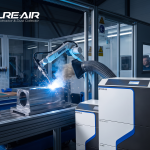
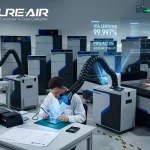
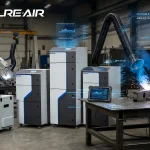
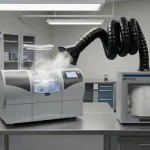
Industrial processes such as welding, laser cutting, soldering, and chemical handling often generate fumes that can threaten worker safety, damage equipment, and reduce overall air quality. An industrial air purifier plays a crucial role in removing these airborne contaminants. However, its effectiveness depends heavily on three technical factors: airflow, capture velocity, and filtration efficiency. Understanding how these elements interact helps businesses select the right air purification system and maintain a safer workplace environment.
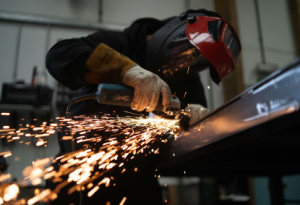
Airflow: The Foundation of Effective Fume Removal
Airflow refers to the volume of air an industrial air purifier can move within a given period, typically measured in cubic feet per minute (CFM) or cubic meters per hour (m³/h). It determines how quickly contaminated air can be drawn away from the source and processed through the filtration system.
When airflow is insufficient, fumes may disperse into the surrounding workspace before the purifier can capture them. This results in poor air quality and exposes workers to hazardous particles or gases
High airflow systems provide several advantages:
- Faster contaminant removal: Polluted air is quickly pulled into the purifier.
- Improved coverage area: Larger spaces can be effectively ventilated.
- Reduced fume dispersion: Contaminants are removed before they spread.
However, airflow must be balanced with system design. Excessively high airflow without proper control may disturb the fume plume and actually reduce capture efficiency. Therefore, industrial air purifier systems must be engineered to deliver stable, directed airflow rather than simply higher volume.
Capture Velocity: Ensuring Fumes Enter the System
Capture velocity refers to the speed of air required to pull fumes into the collection hood or inlet of an industrial air purifier. This factor is especially important for localized fume sources such as welding torches or soldering stations.
If capture velocity is too low, fumes will rise or drift away before they are captured. On the other hand, appropriate capture velocity ensures contaminants are immediately drawn into the purifier.
Several factors influence the required capture velocity:
- Distance from the fume source
- Temperature and buoyancy of fumes
- Air currents in the workspace
- Type and density of contaminants
For example, hot welding fumes rise rapidly due to thermal lift. To control them effectively, the industrial air purifier must generate sufficient capture velocity near the source to overcome this upward movement.
In practice, this often involves designing extraction arms, hoods, or localized intake points positioned close to the emission source. The closer the inlet is to the source, the lower the capture velocity required for effective fume control.
Filtration: The Final Barrier Against Harmful Particles
Once fumes enter the system, filtration determines whether contaminants are actually removed from the air. Even with strong airflow and capture velocity, ineffective filters will allow harmful particles to pass through.
Industrial air purifier systems typically use multi-stage filtration, which may include:
- Pre-Filters
Pre-filters capture larger particles such as dust and debris. This stage protects downstream filters from clogging and extends the system’s service life.
- HEPA Filters
High-Efficiency Particulate Air (HEPA) filters remove extremely fine particles, often capturing 99.97% of particles as small as 0.3 microns. These filters are essential in environments where fine particulate fumes are generated.
- Activated Carbon Filters
Some industrial fumes contain volatile organic compounds (VOCs) or chemical odors. Activated carbon filters adsorb these gases and help eliminate unpleasant smells or hazardous vapors.
Together, these filtration stages ensure that air released back into the workspace is significantly cleaner and safer.
Applying Principles of Industrial Air Purifiers in Laser Processing Environments
In laser-based manufacturing processes such as laser marking, engraving, and coding, the interaction between the laser beam and the material generates a mixture of ultrafine particulate matter, smoke, and chemical vapors. These emissions often occur at a fixed processing point and can quickly disperse into the surrounding workspace if not captured effectively. In such scenarios, the performance of an industrial air purifier depends on how well the system integrates airflow capacity, source capture capability, and high-efficiency filtration.
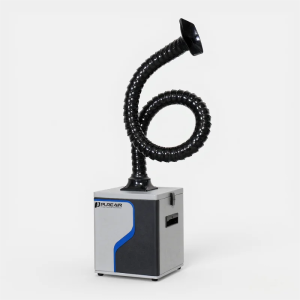
The PUREAIR Laser Marking & Coding Fume Extractor is designed for these types of industrial environments. It is engineered to handle fumes generated during CO₂, fiber, and UV laser marking processes, where toxic gases, fine dust, and odors may be produced during the marking or coding of materials such as stainless steel, plastics, cartons, PET, PC, PCBs, and semiconductor components.
Airflow Capacity for Continuous Industrial Operation
Laser production environments require stable air movement to prevent fume accumulation around processing equipment. PUREAIR systems offer a wide range of airflow configurations—from 250 m³/h to 2400 m³/h—allowing facilities to select the appropriate extraction capacity based on workstation size, enclosure design, or production line layout.
In addition to airflow volume, the system provides high static pressure performance up to 10,000 Pa, enabling the unit to maintain consistent extraction even when ducting resistance or filter loading increases during operation.
Source-Level Capture with High Negative Pressure
Effective fume control begins with capturing emissions before they spread into the workspace. The PUREAIR’s extractor uses high negative-pressure fans combined with localized extraction inlets, allowing smoke and particulate generated during laser processing to be captured directly at the emission point.
This source-capture approach helps maintain stable air quality around the laser station while preventing contamination of optical components or sensitive electronic equipment.
Multi-Stage Filtration for Particles and Gases
Once captured, contaminants must be removed through a reliable filtration architecture. Our PUREAIR system uses a multi-stage filtration configuration, typically consisting of:
- Pre-filters to intercept larger particles
- F5/F9 intermediate filters to remove fine particulate matter
- H14 HEPA filters capable of capturing 99.99% of particles at 0.3 μm
- Activated carbon modules for adsorption of odors and gaseous contaminants
This layered filtration design allows the system to address both particulate smoke and volatile compounds generated during laser processing.
Designed for Industrial Production Environments
Because of these capabilities, our industrial air purifier can be integrated into a variety of manufacturing environments, including automotive components, electronics manufacturing, PCB production, semiconductor packaging, and food or pharmaceutical coding lines, where laser marking is frequently used for traceability and product identification.
Conclusion
Effective fume control in industrial environments relies on the coordinated performance of airflow, capture velocity, and filtration. When these three elements are properly engineered, an industrial air purifier can capture contaminants at the source, maintain stable air circulation, and remove both particulate matter and harmful gases before clean air is returned to the workspace. This integrated approach is essential for maintaining safe working conditions, protecting sensitive equipment, and ensuring compliance with environmental and occupational health standards.
Behind these solutions, PUREAIR brings strong industry expertise. We have focused on industrial fume and dust purification for over 14 years, serving 5,000+ customers across more than 70 countries and supporting 30+ industries including laser processing, electronics, and automotive manufacturing. With 50+ patents and multiple core technologies, we have developed reliable industrial air purifier systems designed for demanding production environments, helping manufacturers maintain cleaner, safer, and more efficient operations.
Contact us today!