Introduction
Industrial production processes generate a wide range of airborne pollutants that are often invisible but highly hazardous. Smoke, dust, and harmful fine particles are common by-products of laser processing, welding, soldering, grinding, and other manufacturing operations. Without effective control, these contaminants can seriously impact worker health, equipment reliability, and environmental compliance.
Understanding the different types of industrial fumes is the first step in selecting the right industrial fume extraction system. As a professional manufacturer with over 14 years of experience, PURE-AIR designs industrial fume extractors specifically engineered to handle complex industrial pollutants.
Image suggestion:
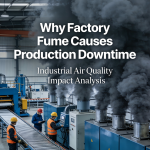
Industrial workshop with visible smoke and dust generated during production
1. Industrial Smoke
What Is Industrial Smoke?
Industrial smoke consists of extremely fine airborne particles produced during high-temperature processes such as laser cutting, welding, soldering, and thermal treatment. These particles are often smaller than 1 micron, allowing them to remain suspended in the air for long periods.
Common Sources:
Laser cutting and engraving
Welding and brazing
Soldering and reflow processes
Risks of Industrial Smoke:
Penetrates deep into the lungs
Causes respiratory irritation and long-term health issues
Reduces visibility and workplace safety
Image suggestion:
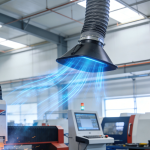
Smoke generated during laser cutting captured by fume extractor
2. Industrial Dust
What Is Industrial Dust?
Industrial dust refers to solid particulate matter generated by mechanical processes. Compared to smoke, dust particles are usually larger but can still pose serious health and operational risks when inhaled or accumulated.
Common Sources:
Grinding and polishing
Sanding and cutting
Material handling and packaging
Risks of Industrial Dust:
Lung diseases such as pneumoconiosis
Dust accumulation on machinery
Fire and explosion hazards in certain environments
Fine dust (PM2.5 and PM10) is especially dangerous because it can bypass natural respiratory defenses.
Image suggestion:
Dust particles generated during grinding process
3. Harmful Fine Particles and Chemical Pollutants
What Are Harmful Industrial Particles?
Harmful particles include ultra-fine particulate matter and gaseous pollutants such as volatile organic compounds (VOCs), acids, and metal fumes. These contaminants often result from chemical reactions or material decomposition under heat.
Common Sources:
Plastic and rubber processing
Chemical coating and painting
Electronics manufacturing
Risks of Harmful Particles:
Toxic exposure and chronic illness
Strong odors affecting work environment
Environmental pollution and regulatory violations
Because these pollutants are often invisible, they pose hidden but significant risks.
Image suggestion:
Diagram showing fine particles and VOCs in industrial air
Differences Between Smoke, Dust, and Harmful Particles
| Type | Particle Size | Visibility | Typical Risk |
|---|---|---|---|
| Smoke | < 1 μm | Often visible | Deep lung penetration |
| Dust | 2.5–100 μm | Visible | Respiratory & fire risk |
| Harmful Particles | < 0.1 μm / gas | Invisible | Toxic & chemical exposure |
Understanding these differences is critical for choosing appropriate filtration technology.
Why One Solution Does Not Fit All
Different types of industrial fumes require different filtration strategies:
Smoke requires high-efficiency fine filtration
Dust needs robust pre-filtration and airflow design
Harmful particles demand activated carbon or chemical adsorption
A professional industrial fume extractor integrates multi-stage filtration and high negative pressure airflow to address all pollutant types efficiently.
PURE-AIR Solutions for Different Industrial Fumes
PURE-AIR industrial fume extractors are designed with:
High negative pressure fan systems
Multi-layer long-life filters
Intelligent purification and monitoring (PIPS System)
This ensures stable and efficient removal of smoke, dust, and harmful particles across diverse industrial applications.
Conclusion
Smoke, dust, and harmful particles represent distinct categories of industrial air pollution, each requiring specialized control methods. Proper identification of pollutant types allows manufacturers to select the most effective industrial fume extraction solutions, ensuring safer workplaces and compliant operations.
PURE-AIR provides reliable, industrial-grade fume extractors designed for long-term performance and professional manufacturing environments.