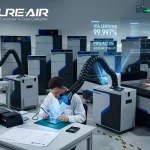
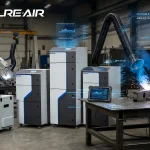
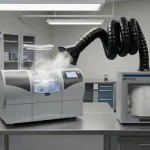
Across the industrial world, the need for effective air management is a constant. However, the specific demands for dust and fume extraction can differ significantly between long-standing industrial fields and newer, innovative sectors. At PURE-AIR, our work across diverse global applications has given us a clear view of these distinctions. The core challenge lies not in the importance of clean air, but in how the requirements for an industrial fume extraction system are defined by a sector’s maturity, processes, and regulatory environment. Recognizing these differences is fundamental to deploying the right solution.
Foundational Priorities: Reliability in Known Environments
For established industries, the parameters are often well-defined. Processes are standardized, and the types of fumes or particulates generated are familiar and documented. The primary requirement here leans heavily on proven reliability and seamless integration into existing, high-volume production lines. The focus for a dust and fume extraction system in these settings is on unwavering uptime, durable components that withstand continuous operation, and ease of maintenance with minimal disruption. The design philosophy centers on creating a robust, set-and-forget component of a larger, stable ecosystem. We have seen that success in these areas is built on deep, sector-specific experience.
Adaptive Solutions for Dynamic Processes
In contrast, emerging sectors frequently operate at the frontier of new materials and methods. Their processes can evolve rapidly, and the chemical or particulate profiles of emissions may be less characterized initially. This places a different set of demands on an industrial fume extraction system. Flexibility and adaptability become paramount. The system must be capable of handling a wider or changing range of contaminants and might need to be reconfigured as research scales to pilot production. For us, engagement in these sectors involves a more collaborative approach to risk assessment and solution design, ensuring the air safety infrastructure can evolve alongside the core technology it supports.
Engineering for Diverse Contaminant Profiles
The heart of the distinction often lies in the contaminant itself. Mature industries typically deal with known hazards—specific metal fumes, consistent dust particulates, or familiar solvents. This allows for precise engineering of filtration stages and fan specifications. Newer industries might introduce novel composite materials or unique chemical reactions, requiring a more comprehensive initial analysis and possibly a broader-spectrum or more easily adaptable filtration approach. Our own development of core components, like proprietary brushless fans and purification modules, is driven by the need to create systems that offer both specific high performance and the capability to adapt to emerging challenges identified in collaboration with our clients.
In summary, the journey toward optimal industrial air safety is not a single path. Established sectors require the deep reliability that comes from focused experience, while emerging fields necessitate adaptable and forward-looking partnership. With over fourteen years of dedicated R&D in dust and fume extraction, supplying systems to numerous global industries, we at PURE-AIR understand that a effective industrial fume extraction system must be more than a standard product. It is a tailored application of engineering principles, whether ensuring steadfast performance in a familiar setting or building a scalable solution for the innovations of tomorrow. The goal remains the same: to provide air purity that is as certain as it is critical.