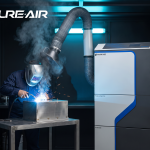
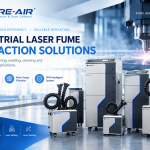
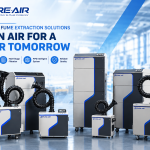
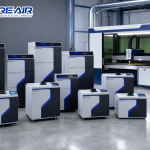
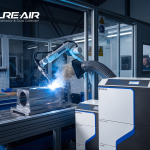
A laser machine may complete a cut, mark, engraving, weld, cleaning pass, or drilling cycle in seconds, but the airborne residue can remain in the workplace much longer. Laser processing commonly produces smoke, fine dust, harmful gases, and irritating odors. Without effective source capture, these pollutants may affect operators, precision equipment, product quality, and the wider workshop environment.
The right extraction system should therefore be selected around the actual process rather than a generic equipment label. Laser type, processed material, enclosure size, production hours, contaminant loading, duct length, and required airflow all influence the final configuration. This practical guide explains how manufacturers, distributors, and production managers can make a more informed decision while using verified capabilities from PURE-AIR’s official product range.
Begin with the Process and the Material
Different Lasers Create Different Extraction Demands
PURE-AIR laser extraction systems support CO₂, YAG, and fiber laser applications, with solutions for marking, coding, cutting, engraving, etching, drilling, welding, cleaning, and cladding. Each process creates a different combination of particulates, fumes, and odors.
A co2 laser fume extractor is frequently required for non-metal processing such as acrylic, plastic, leather, fabric, paper, wood, and plywood. These applications do not generate one uniform pollutant. Acrylic and plastic processing can release visible smoke, odors, VOCs, and irritating gases, while wood and plywood can add heavier dust, resinous residue, and persistent odor. For this reason, capture performance and filter configuration should be matched to the processed material and daily workload.
A laser cutter fume extractor used beside an enclosed desktop machine may require a very different airflow and inlet arrangement from a system connected to a large-format production line. PURE-AIR’s published laser range covers adaptive airflow capacities from 20 to 5,000 m³/h, allowing solutions to be selected for both precision source capture and higher-volume industrial extraction.
PCB and Electronics Processing Need Precise Source Capture
PCB and 3C electronics production are listed among PURE-AIR’s laser application industries. When specifying a pcb laser cutting fume extractor, buyers should consider the working area, laser power, processed board composition, production speed, and the type of airborne residue produced by the actual operation. Placing extraction close to the emission point helps prevent fine particulate and fumes from spreading around sensitive electronics and optical components.
Rather than choosing solely by machine footprint, production teams should provide application details to the extraction supplier. This makes it easier to determine the appropriate suction, inlet diameter, filtration combination, and replacement schedule.
Evaluate the Complete Filtration Path
Capture Smoke Before It Spreads
An effective toxic smoke laser fume extractor begins with stable source capture. Suction must be strong enough to draw contaminants away from the laser process, but it should also remain consistent as filters gradually collect dust. PURE-AIR develops high-negative-pressure extraction solutions and offers product configurations with published pressure ratings reaching 10,000 Pa in parts of its non-metal laser range.
Filtration must then address both particulate and gas-phase contamination. PURE-AIR’s laser systems use multi-stage configurations that combine pre-filtration, high-efficiency filtration, and treated activated carbon. On the official laser product pages, H14 deep-pleat filters are specified at 99.997% efficiency for 0.3 μm particles, while activated carbon is used to treat gaseous contaminants and odors.
Understand the Main Laser Fume Extractor Parts
Purchasing decisions should include the complete service path, not only the extractor cabinet. Important laser fume extractor parts include the pre-filter, main HEPA filter, activated-carbon module, blower, inlet connection, extraction hose, control interface, and monitoring components. Their condition directly affects capture stability, filtration performance, maintenance time, and operating cost.
PURE-AIR’s modular designs are intended to simplify filter servicing. Depending on the series, official product information also describes real-time airflow displays, filter-status alerts, and tool-free cartridge replacement. These functions help operators replace consumables at the right time instead of relying only on a fixed calendar.
Plan for Continuous Industrial Operation
Stable Airflow Matters as Filters Load
An industrial laser fume extractor must continue performing through changing production conditions. As collected material increases filter resistance, an unmanaged system may lose effective airflow at the source. PURE-AIR’s Intelligent Purification System, PIPS, uses sensors and AI-based control to adjust airflow according to filter blockage, helping maintain the set air volume.
PIPS also provides real-time filter monitoring so that maintenance teams can respond before a blocked filter causes avoidable downtime. Depending on the configured sensors, the system can monitor parameters including PM1.0, VOC, O₃, HCl, and odor. Alarm and shutdown thresholds can be configured to suit different operating requirements.
Durability, Noise, and Integration Also Count
Extraction equipment often operates beside production staff and automated machinery. PURE-AIR’s non-metal laser product range includes brushless motors with a published maintenance-free service life of more than 30,000 hours. Published noise values vary by model and operating condition, so buyers should compare the specific unit rather than assume that every system has the same acoustic performance.
For automated lines, controls and interfaces may be just as important as airflow. Selected PURE-AIR series support equipment linkage, real-time performance monitoring, and industrial communication options. These capabilities can help synchronize extraction with the laser process and support maintenance planning in a smart-factory environment.
Build a Better Bulk or Wholesale Purchasing Plan
Standardize Without Ignoring the Application
A bulk laser fume extractor project should not mean ordering one configuration for every workstation. A better approach is to group production points by laser process, material, enclosure size, airflow demand, and duty cycle. Standardization can then be applied within each group, simplifying operator training, spare-filter planning, and maintenance procedures without compromising extraction performance.
Buyers should also confirm electrical requirements, inlet sizes, available floor space, duct routing, noise targets, and the required filter media before finalizing a larger order. PURE-AIR’s non-metal laser range includes models for multiple working formats, with published airflow options from 300 to 2,400 m³/h and different pressure, power, inlet, and cabinet specifications.
Support Distributors with Repeatable Product Selection
For a wholesale laser fume extractor program, long-term value depends on more than the initial unit price. Distributors and integrators need a product portfolio that can serve compact laser stations, non-metal cutting, high-load wood processing, composite applications, and intelligent production lines. They also need predictable access to consumable filters and technical selection support.
PURE-AIR has more than 15 years of experience in fume and dust extraction, works with over 5,000 customers in more than 75 countries, and serves over 30 industries. The company develops its own brushless fans and purification systems and reports more than 50 patents. Its official partnership program also includes regional and industry protection options,
launch incentives, filter-purchase support, and selected customization opportunities for qualifying partners.
Why PURE-AIR Is a Practical Clean-Air Partner
PURE-AIR combines source capture, multi-stage filtration, activated-carbon treatment, high-negative-pressure fans, and intelligent monitoring within a broad laser-processing portfolio. Solutions are available for laser marking and coding, non-metal and metal cutting, engraving, drilling, welding, cleaning, and cladding.
The product range can be matched to compact workstations or larger industrial systems instead of forcing every application into a single design. With CE and ISO 9001 credentials presented on the official website, dedicated laser product families, and application support across electronics, automotive, additive manufacturing, digital printing, and new-energy production, PURE-AIR provides a scalable route from one workstation to a multi-line clean-air program.
Turn Cleaner Air into More Reliable Production
Laser fumes should not be treated as an unavoidable side effect of manufacturing. Effective source capture helps create a cleaner workshop, supports equipment protection, and gives production teams greater confidence in daily operation. The best system begins with accurate process information and ends with an extraction configuration built around the real pollutant load.
Whether you are upgrading one CO₂ laser, planning a PCB production area, standardizing extraction across several cutting machines, or developing a regional distribution business, PURE-AIR can help evaluate your process and recommend a suitable solution. Share your laser type, material, working area, production hours, and installation conditions with the PURE-AIR team to request a tailored selection and quotation. Choose a clean-air partner with proven global application experience—and make safer, smarter laser production part of your competitive advantage.