Introduction: Is Frequent Filter Replacement Really Normal?
One of the most common questions from manufacturers after installing an industrial fume extractor is:
“Why does my filter need to be replaced after only a few months?”
Many people assume the filter quality is poor. In reality, premature filter clogging is often caused by improper system design, unsuitable equipment selection, or incorrect operating practices—not by the filter itself.
A clogged filter does more than increase replacement costs. It can also reduce airflow, lower collection efficiency, increase energy consumption, and shorten the lifespan of the entire extraction system.
In this article, we’ll explore the five most common reasons why industrial fume extractor filters clog too quickly and how manufacturers can avoid these costly mistakes.
- Choosing the Wrong Filtration System
The first and most common mistake is selecting equipment that is too small for the application.
For example, a compact fume extractor designed for light laser engraving may be used in a heavy-duty laser cutting workshop that generates a much higher concentration of smoke and dust.
When the filtration system operates beyond its designed capacity:
- Filters become overloaded quickly.
- Airflow drops significantly.
- Maintenance intervals become much shorter.
- Operating costs increase.
The correct solution is to size the extraction system according to:
- Material type
- Dust concentration
- Smoke generation rate
- Operating hours
- Number of workstations
Selecting the right system from the beginning can dramatically extend filter service life.
- No Pre-Filter Protection
Many users focus only on the HEPA filter and overlook the importance of pre-filtration.
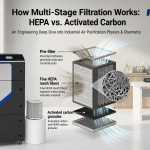
However, the pre-filter is the first line of defense in a multi-stage filtration system.
Its primary function is to capture larger dust particles before they reach the more expensive HEPA filter.
Without effective pre-filtration:
- Large particles directly load the HEPA filter.
- Air resistance increases rapidly.
- The HEPA filter reaches its capacity much sooner.
- Replacement costs rise significantly.
A properly designed multi-stage filtration system distributes contaminants across different filter stages, improving filtration efficiency while reducing long-term maintenance expenses.
- Incorrect Airflow Design
Even a high-quality filter cannot perform efficiently if the airflow is poorly designed.
Common airflow problems include:
- Insufficient airflow volume
- Low static pressure
- Long duct runs with excessive resistance
- Collection hoods positioned too far from the smoke source
When smoke is not captured immediately, airborne particles continue circulating through the workshop before eventually reaching the filter.
As a result:
- More contaminants accumulate inside the filtration system.
- Filters load unevenly.
- Dust settles on machines and surrounding equipment.
Proper airflow design should prioritize source capture, ensuring contaminants are removed before they disperse into the working environment.
If you’re unsure how to calculate airflow requirements, static pressure, or equipment capacity, check out our: Industrial Fume Extractor Selection Guide
- Continuous Overload Operation
Industrial fume extractors are designed to operate within a specified performance range.
In many factories, however, equipment runs continuously for multiple shifts without sufficient maintenance or inspection.
Typical examples include:
- 24/7 production lines
- High-volume laser cutting
- Continuous welding operations
- Heavy-duty grinding applications
Long-term overload operation causes filters to collect contaminants much faster than expected.
It may also increase:
- Fan energy consumption
- System pressure loss
- Mechanical wear
- Motor operating temperature
Regular inspections and scheduled filter maintenance help maintain consistent airflow while protecting the entire extraction system.
- Poor Maintenance Habits
Even the best filtration system requires routine maintenance.
Unfortunately, some factories wait until suction performance has noticeably declined before checking the filters.
Common maintenance mistakes include:
- Ignoring pressure indicators
- Delaying filter replacement
- Failing to clean pre-filters
- Operating with damaged filters
- Using non-original replacement filters
Preventive maintenance is always more cost-effective than emergency repairs.
A simple maintenance schedule can significantly extend filter life while maintaining stable extraction performance.
How PURE-AIR Helps Reduce Filter Replacement Costs
At PURE-AIR, we believe that lowering operating costs starts with intelligent system design—not simply replacing filters more often.
Our industrial fume extraction solutions are engineered with features that maximize filter lifespan while maintaining high collection efficiency.
Multi-Stage Filtration Design
Separate filtration stages capture contaminants of different particle sizes, protecting the HEPA filter and extending its service life.
Filter Replacement Reminder
The intelligent control system reminds operators when filters require replacement based on actual operating conditions rather than fixed schedules.
Smart Pressure Monitoring
Real-time differential pressure monitoring allows maintenance teams to identify filter loading before airflow performance is affected.
To explore systems designed for longer filter life and lower maintenance costs, visit our:Laser Fume Extraction Solutions
Best Practices for Maximizing Filter Lifespan
Manufacturers can significantly reduce maintenance costs by following these recommendations:
- Select equipment based on actual application requirements.
- Use multi-stage filtration with effective pre-filters.
- Design proper airflow and duct layouts.
- Avoid continuous overload operation whenever possible.
- Monitor filter condition regularly.
- Replace filters according to system performance—not simply on a fixed schedule.
These practices help maintain stable airflow, improve collection efficiency, and reduce the total cost of ownership.
Conclusion
A filter that clogs too quickly is usually a symptom of a larger system issue rather than a filter quality problem.
By selecting the right equipment, implementing multi-stage filtration, optimizing airflow design, and adopting preventive maintenance practices, manufacturers can significantly extend filter life while lowering operating costs.
For facilities that rely on laser cutting, welding, grinding, or other smoke-generating processes, investing in a professionally designed industrial fume extraction system is one of the most effective ways to improve productivity, protect equipment, and achieve long-term cost savings. Want longer filter life and lower maintenance costs? Follow PURE-AIR FACEBOOK PAGE for practical filtration tips.