How Many CFM for Welding Fume Extractor?
Determining the appropriate volumetric airflow rate, measured in Cubic Feet per Minute (CFM), is the most critical decision a facility manager faces when deploying air purification hardware. Welding processes generate heavy thermal plumes containing toxic heavy metal particles, fluorides, and hazardous gases. Capturing these rapidly expanding contaminants before they disperse into the factory breathing zone requires precise aerodynamic calculations. Selecting an inadequate CFM rating allows hazardous fumes to escape into the manufacturing environment, risking regulatory non-compliance and health liabilities. Conversely, over-specifying system capacity wastes electrical energy and accelerates filter degradation. Achieving the ideal performance balance requires a comprehensive understanding of industrial air movement and localized ventilation dynamics, which is why modern facilities rely on advanced fume extraction technology from recognized industry experts like PURE AIR to maintain full operational safety and high performance on the shop floor.
Defining CFM and Its Critical Importance in Source Capture
To establish a safe and compliant manufacturing workspace, industrial buyers must understand the relationship between volumetric airflow and capture velocity. In industrial air filtration, CFM measures the total volume of air an extraction unit moves through its filter matrix every minute. However, the success of a system depends on achieving the correct capture velocity at the welding torch or workstation. Capture velocity is the speed necessary to overcome ambient cross-drafts and pull hazardous particulates directly into the collection hood. Higher particle weights and fast thermal currents require a stronger suction velocity, which directly influences the minimum CFM required by the extraction fan. Utilizing high-efficiency fume extraction technology ensures that the system maintains this vital velocity threshold, even as filters gradually load with heavy metallic dust over time.
A common mistake in B2B procurement is focusing exclusively on the raw CFM rating of an extraction fan while ignoring static pressure. Static pressure represents the internal resistance within the filtration circuit, including the resistance from dense filter elements, flexible extraction arms, and structural ducting. As toxic welding soot accumulates within primary HEPA filters, internal resistance increases significantly. A premium filtration system must feature a high-pressure fan curve capable of maintaining its targeted CFM output under heavy loading. Without adequate static pressure capability, the effective airflow drops rapidly, rendering the ventilation system incapable of clearing workplace smoke and exposing the plant to hazardous accumulation.
Baseline CFM Guidelines for Different Welding Applications
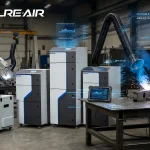
Airflow requirements vary drastically depending on the specific welding method, material composition, and size of the fabrication workspace. For manual, low-volume Gas Tungsten Arc Welding (TIG) or Gas Metal Arc Welding (MIG) applications on small components, airflow demands are relatively modest. When utilizing a localized extraction nozzle positioned close to the weld pool, a baseline airflow of 100 to 200 CFM is typically sufficient. This compact configuration creates a concentrated vacuum field that draws in fine fumes without pulling away shielding gases. Integrating localized fume extraction technology at this scale protects operators efficiently while keeping machinery footprints small and energy costs minimal.
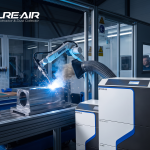
Heavy-duty fabrication involving flux-cored wires, high-amperage welding, or automated robotic cells generates a continuous, dense cloud of metallic smoke. Robotic welding enclosures feature rapid, multi-axis movements that create complex air currents, requiring much larger volumes of air management to control the workspace environment. To completely clear these automated production zones, systems usually require an airflow ranging from 600 to over 1200 CFM per welding station. Deploying heavy-duty fume extraction technology across these high-output lines ensures rapid air turnover, keeping delicate robotic sensors clean and protecting the surrounding facility from settling carbon dust.
Key Variables that Influence Your Final CFM Calculations
Calculating the exact airflow capacity for a factory floor requires looking beyond the welding torch to evaluate the entire physical workstation layout. The distance between the hood opening and the welding arc is the single most influential variable affecting total CFM requirements. Air velocity drops off exponentially as the distance from the extraction inlet increases, following the principle of the inverse square law. Moving a collection hood just a few inches away from the welding zone requires a massive increase in system CFM to maintain the same capture efficiency. For environments where operators require freedom of movement, choosing advanced fume extraction technology with wider capture zones helps maintain clean air without requiring constant manual adjustments.
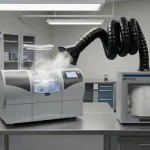
The physical dimensions of the extraction ductwork introduce mechanical resistance that directly affects fan performance over time. Standard flexible extraction arms typically feature diameters of six or eight inches, with each size possessing strict aerodynamic limits. A six-inch arm can safely carry approximately 500 to 600 CFM before frictional resistance causes excessive noise and pressure drops. Forcing higher air volumes through narrow channels strains internal fan motors and spikes monthly energy usage. Selecting matching duct diameters is essential to ensure that your industrial air systems deliver their rated airflow reliably across consecutive shifts without causing premature hardware failure.
The Operational Benefits of Implementing Correct Airflow Systems
Investing in a precisely calibrated air purification strategy provides substantial long-term financial and compliance benefits for commercial manufacturing enterprises. Welding smoke contains hazardous compounds, including hexavalent chromium, manganese, and lead oxides, which present severe occupational health risks. Prolonged inhalation of these toxic particulates leads to acute respiratory irritation, chronic lung illnesses, and serious corporate legal liabilities. Implementing highly efficient fume extraction technology draws these dangerous emissions out of the operator’s breathing zone instantly, helping facilities meet strict environmental legislation. Maintaining clean workplace air reduces employee absenteeism, improves daily assembly focus, and safeguards companies against costly regulatory penalties.
High-precision automated manufacturing equipment and laser optics are highly sensitive to settling metallic dust and fine carbon soot. If uncollected, floating conductive dust settles onto sensitive electronic enclosures, causing electrical shorts, positioning drifts, and premature machinery breakdowns. Maintaining optimal CFM configurations prevents this micro-contamination entirely, lowering equipment maintenance costs and maximizing first-pass production yields. By utilizing advanced air setups engineered by specialist brands, manufacturing facilities preserve their massive capital investments and enhance overall business profitability.
Tailored Air Engineering with PURE AIR Solutions
Achieving the perfect balance of airflow and filtration efficiency requires rugged hardware built specifically for the grueling demands of heavy manufacturing. Standard commercial air scrubbers lack the necessary combination of vacuum pressure and structural durability to handle heavy metal processing smoke. The advanced industrial systems developed by PURE AIR combine heavy-duty structural pre-filters, high-capacity carbon gas-phase modules, and certified HEPA media. This multi-stage engineering strategy ensures the equipment captures 99.97% of airborne micro-particles down to 0.3 micrometers, ensuring consistent air purity through demanding manufacturing cycles.
Every production facility operates with distinct tool layouts, floor constraints, material types, and unique production volumes. Optimizing your factory air management strategy requires selecting exact airflow rates and localized configurations tailored to your specific machinery lines. For manufacturing enterprises looking to optimize production efficiency, protect automated machinery investments, and secure total workplace safety, the technical team at PURE AIR provides robust, field-tested systems designed for seamless integration.
To learn more about how our high-capacity fume extraction technology can protect your facility and streamline operations, contact us today for an expert engineering consultation.