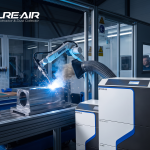
Welding plays a critical role in modern manufacturing, from automotive assembly and heavy machinery production to metal fabrication and precision laser welding. While these processes deliver strong and reliable joints, they also generate airborne contaminants that can affect both workplace conditions and production efficiency.
Many factories rely on general workshop ventilation or ceiling fans to improve air circulation. However, simply moving contaminated air does not prevent workers from being exposed to fumes generated directly at the welding point.
For manufacturers seeking cleaner production environments, local exhaust ventilation (LEV) combined with a professional welding fume extractor provides a far more effective solution.
- What Is Generated During Welding?
Different welding processes produce different types of airborne pollutants, but most metal welding operations generate a combination of fine particles and gases.
Common contaminants include:
- Metal oxide fumes
- Iron oxide particles
- Chromium compounds
- Nickel compounds
- Welding gases
- Fine airborne particulate matter
Many of these contaminants are microscopic and can remain suspended in the air long after welding has stopped.
Typical applications include:
- Automotive manufacturing
- Metal fabrication
- Machinery production
- Structural steel fabrication
- Stainless steel processing
- Laser welding production lines
Without effective source capture, these airborne pollutants can spread throughout the workshop and settle on equipment and surrounding surfaces.
- Why General Workshop Ventilation Is Not Enough
A common misconception is that installing additional fans or increasing workshop ventilation will solve welding fume problems.
In reality, general ventilation only dilutes contaminants after they have already entered the workplace.
General Workshop Ventilation
❌ Moves contaminated air around the workshop
❌ Cannot effectively capture fumes at the welding torch
❌ Allows operators to inhale contaminants before removal
❌ Provides inconsistent protection for nearby workstations
Because welding fumes are generated directly within the operator’s breathing zone, relying solely on general ventilation leaves workers exposed during the most critical moment.
- Why Local Exhaust Ventilation Works
The most effective strategy for controlling welding fumes is source capture, also known as local exhaust ventilation (LEV).
Instead of allowing smoke to disperse throughout the workshop, LEV captures contaminants immediately as they are generated.
Key benefits include:
- Prevents fumes from entering the operator’s breathing zone
- Reduces airborne particle concentration
- Improves workshop cleanliness
- Minimizes contamination of nearby equipment
- Supports more consistent production conditions
By removing contaminants before they spread, source capture significantly improves overall air quality while reducing the burden on general ventilation systems.
- The Importance of Multi-Stage Filtration
Capturing welding fumes is only the first step.
An effective industrial air purification system must also remove microscopic particles and gaseous pollutants before clean air is returned to the workplace.
A professional multi-stage filtration system typically includes:
Pre-Filter
Captures larger particles and welding dust, protecting downstream filters from excessive loading.
HEPA Filtration
Removes fine metal particles generated during MIG, TIG, and laser welding, helping maintain cleaner indoor air.
Activated Carbon Filtration
Adsorbs welding-related odors and certain volatile organic compounds (VOCs) that may be generated during specific welding processes.
- PURE-AIR Welding Fume Extraction Solutions
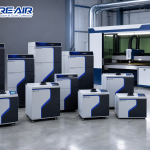
PURE-AIR designs industrial fume extraction systems for a wide range of welding applications.
Our solutions are suitable for:
Welding Stations
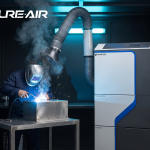
Flexible extraction arms allow operators to position the capture hood close to the welding point for maximum collection efficiency.
Robotic Welding Cells
Compact extraction systems integrate with automated welding equipment while maintaining stable airflow during continuous production.
Production Lines
Centralized or standalone extraction solutions support multiple welding workstations and high-volume manufacturing environments.
Key features include:
- Flexible extraction arms
- High-vacuum airflow
- Multi-stage filtration
- Stable suction performance
- Intelligent monitoring options for selected models
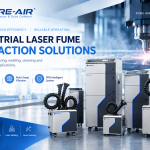
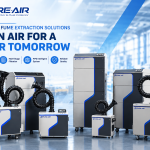
Explore our complete range of: Welding & Laser Fume Extraction Solutions
- Choosing the Right Welding Fume Extractor
Selecting the right extraction system depends on several factors, including:
- Welding process (MIG, TIG, Laser, Spot Welding)
- Material type
- Number of welding stations
- Production volume
- Airflow requirements
- Installation environment
A properly sized system delivers more efficient source capture, longer filter life, and lower operating costs.
For more guidance, read our: Industrial Fume Extractor Selection Guide
Best Practices for Cleaner Welding Environments
To improve air quality and maintain efficient welding operations:
- Position extraction hoods as close to the welding arc as possible.
- Select airflow capacity based on the welding process.
- Use multi-stage filtration with HEPA technology.
- Inspect filters regularly and replace them when required.
- Train operators to keep extraction systems operating throughout the welding process.
- Perform preventive maintenance to ensure stable airflow.
Following these practices helps improve air quality, maintain equipment performance, and support long-term operational efficiency.
Conclusion
Welding fumes contain fine particles and gases that are generated directly in the operator’s breathing zone. Because these contaminants spread rapidly, relying on general workshop ventilation alone is rarely sufficient.
A professional welding fume extractor equipped with local exhaust ventilation, high-vacuum airflow, and multi-stage filtration captures pollutants at the source before they disperse throughout the factory.
Whether for manual welding stations, robotic welding cells, or automated production lines, effective welding fume extraction helps manufacturers create cleaner working environments, protect valuable equipment, and improve overall production efficiency.
Working with welding fumes every day? Discover how PURE-AIR helps factories create cleaner welding environments with source-capture extraction, high-vacuum airflow, and multi-stage filtration. Learn more today!