Introduction: Clean Manufacturing Is Becoming a Global Requirement
Global manufacturing is changing.
For many years, manufacturers competed primarily on product quality, production capacity, delivery time, and cost. Today, global customers and large manufacturing groups are increasingly looking beyond the final product.
They are also paying attention to how products are manufactured.
Environmental responsibility, worker safety, production conditions, and sustainable manufacturing practices are becoming increasingly important considerations throughout global supply chains.
For suppliers serving international customers, this means that maintaining a cleaner production environment is no longer simply an internal factory management issue.
It can become part of the broader manufacturing and supplier evaluation process.
One important component of this transition is the use of an industrial air purification system to manage airborne contaminants and create a cleaner, more controlled production environment.
- Why Green Manufacturing Is Becoming More Important
Modern supply chains are increasingly focused on three major areas:
- ESG requirements
- Worker safety
- Sustainable manufacturing
Large manufacturers and international buyers increasingly expect their suppliers to demonstrate responsible production practices alongside consistent product quality.
This creates a new standard for manufacturing facilities.
A supplier may produce high-quality components, but customers may also consider questions such as:
- Is the production environment clean and well managed?
- Are airborne contaminants properly controlled?
- Are workers provided with a safer working environment?
- Does the factory have effective environmental management practices?
- Can the supplier demonstrate continuous improvements in production conditions?
As a result, manufacturers need to think beyond the product itself.
Clean production is becoming part of manufacturing competitiveness.
- How Air Quality Can Affect Manufacturing Competitiveness
Factory air quality is closely connected with the overall production environment.
Industrial processes such as laser processing, welding, grinding, cutting, soldering, and other manufacturing operations can generate dust, fumes, fine particles, and other airborne contaminants.
Without effective control, these contaminants can settle on equipment, work surfaces, and products.
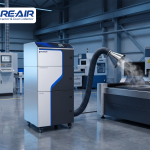
A properly designed industrial air purification system helps capture and filter these contaminants at appropriate points within the production environment.
This can support three important areas of factory performance.
Product Quality
Dust and airborne particles can become unwanted contaminants during manufacturing.
Depending on the production process, airborne contamination may contribute to:
- Dust accumulation
- Surface contamination
- Product defects
- Unstable processing conditions
Maintaining cleaner production areas can help manufacturers reduce unnecessary contamination risks and create more consistent working conditions.
For precision manufacturing, electronics production, optical applications, and other contamination-sensitive processes, maintaining controlled air quality can be particularly important.
- Employee Safety and Workplace Conditions
People are at the center of every manufacturing operation.
Industrial processes can generate airborne particles and fumes that operators may encounter during daily production.
Effective source extraction and air purification can help reduce airborne contaminant concentrations in the workplace and support a cleaner production environment.
This is especially relevant for factories with:
- Continuous welding operations
- Laser processing
- Grinding and polishing
- Soldering
- Metal fabrication
- High-volume automated production
Rather than allowing contaminants to spread throughout the workshop, manufacturers can use localized extraction and filtration to control pollutants closer to where they are generated.
The goal is simple:
Capture contaminants before they become a wider workplace air-quality problem.
- Clean Factories Can Support Global Customer Audits
For international suppliers, factory presentation and production management can influence how customers evaluate manufacturing capabilities.
A clean and organized factory can demonstrate that a company takes production management, worker safety, and environmental responsibility seriously.
During customer visits or supplier assessments, visible air purification equipment can also demonstrate that the manufacturer has invested in managing its production environment.
An effective air management strategy can therefore support broader factory management objectives, including:
- Cleaner production areas
- Better workplace organization
- More controlled manufacturing conditions
- Demonstrable environmental management practices
- A more professional factory image
Clean air systems should not be viewed as a substitute for formal ESG or safety requirements. Instead, they can form part of a broader strategy for building a cleaner and more responsible manufacturing environment.
- From a Cleaner Factory to a Smarter Factory
Green manufacturing is not only about reducing environmental impact.
Modern manufacturers are also looking for ways to make production systems more intelligent and efficient.
This is where smart air purification technologies become increasingly valuable.
Traditional air purification systems primarily focus on filtration.
A modern system can go further by monitoring equipment conditions and providing useful operating information.
For example, intelligent monitoring can help manufacturers understand:
- Airflow conditions
- Filter status
- Pressure changes
- Equipment operating conditions
- Maintenance requirements
This creates a connection between clean air management and smart manufacturing.
- PURE-AIR: Cleaner Factory, Safer Workplace, Smarter Manufacturing
PURE-AIR focuses on combining industrial air purification with intelligent technologies to support modern manufacturing environments.
The company’s approach can be summarized in three key objectives:
Cleaner Factory
Effective filtration and extraction help manufacturers manage dust, fumes, and airborne particles generated during production.
A cleaner environment can support better production organization and reduce unnecessary contamination around workstations and equipment.
Safer Workplace
Source extraction and air purification help control airborne contaminants closer to their point of generation.
This supports manufacturers in creating cleaner and more controlled working environments for employees.
Smarter Manufacturing
Modern factories require more than filtration.
PURE-AIR’s PIPS Smart System introduces intelligent monitoring capabilities that can provide information about equipment operating conditions and maintenance requirements.
This allows manufacturers to move toward a more data-driven approach to air management.
- The Role of Intelligent Monitoring in Sustainable Manufacturing
One of the challenges of industrial air purification is balancing filtration performance with long-term operating efficiency.
An intelligent system can help manufacturers better understand how their equipment is operating instead of relying entirely on fixed maintenance schedules.
With intelligent monitoring, manufacturers can track system conditions and identify when attention may be required.
This can support:
- More informed maintenance planning
- Better equipment management
- Reduced unexpected downtime
- More efficient filter management
- More consistent system performance
For factories operating multiple production lines, this type of information becomes increasingly valuable.
Instead of treating every air purification unit as an isolated machine, manufacturers can begin to manage air purification as part of their wider production infrastructure.
- Energy Efficiency and Long-Term Factory Management
Sustainable manufacturing requires manufacturers to consider not only what equipment does, but also how efficiently it operates over time.
An industrial air purification system can therefore be evaluated from several perspectives:
Filtration performance
How effectively can the system capture and filter the contaminants generated by the process?
Airflow management
Is the system delivering appropriate airflow for the application?
Filter utilization
Can filter life be managed according to actual operating conditions?
Maintenance
Can maintenance be planned before performance deteriorates significantly?
Operating efficiency
Can the system provide the required purification performance without unnecessary energy consumption?
These factors contribute to the overall lifecycle value of an air purification system.
For global suppliers, considering lifecycle performance rather than simply the initial equipment price can lead to more sustainable equipment decisions.
- Why Clean Air Matters for Global Suppliers
For manufacturers supplying international customers, the definition of a competitive factory is changing.
A modern supplier needs to demonstrate more than manufacturing capacity.
It needs to demonstrate production capability + quality management + workplace responsibility + environmental awareness.
An effective air management strategy can become one component of this broader manufacturing framework.
The long-term objective is not simply:
“Remove factory fumes.”
It is:
“Build a cleaner, safer, and more intelligent manufacturing environment.”
This mindset aligns closely with the direction of modern green manufacturing.
- Building a More Sustainable Manufacturing Environment
Manufacturers looking to improve their production environment can begin with several practical steps:
- Identify Airborne Contaminant Sources
Determine which production processes generate dust, fumes, smoke, or fine particles.
- Prioritize Source Capture
Capture contaminants as close to their point of generation as possible before they disperse throughout the factory.
- Select the Appropriate Filtration System
Different applications require different filtration strategies. System configuration should match the type and concentration of contaminants being generated.
- Monitor System Performance
Use airflow, pressure, and filter monitoring to understand how the purification system performs over time.
- Plan Preventive Maintenance
Regular inspection and data-based maintenance can help maintain stable system performance and avoid unnecessary downtime.
- Consider Lifecycle Efficiency
Evaluate equipment based not only on initial purchase cost but also on filtration performance, maintenance requirements, energy consumption, and long-term operating costs.
Conclusion: Clean Air Is Part of the Future of Manufacturing
Green manufacturing is no longer limited to energy consumption or waste reduction.
For global suppliers, it increasingly includes the entire production environment—from workplace conditions to contamination control and intelligent equipment management.
An industrial air purification system can play an important role in this transition by helping manufacturers create cleaner production areas, manage airborne contaminants, and support more controlled manufacturing conditions.
When combined with intelligent monitoring technologies such as the PURE-AIR PIPS Smart System, air purification can become part of a broader smart manufacturing strategy.
The future factory is not simply automated.
It is cleaner, safer, smarter, and more sustainable.
Cleaner Factory.
Safer Workplace.
Smarter Manufacturing.
Building a greener factory for global customers? PURE-AIR helps manufacturers achieve cleaner and smarter production environments.