How Often to Replace HEPA Filter in Industrial Air Purifier?
Maintaining optimal indoor air quality in heavy manufacturing and electronic assembly plants requires a strict focus on filtration upkeep. Industrial facilities generate a massive volume of microscopic dust, toxic smoke, and chemical sub-micron particles every single day. The deployment of a high-efficiency HEPA air purifier industrial system remains the primary defense against these invisible operational hazards. However, the efficiency of these systems depends heavily on the condition of their internal filters. Knowing exactly when to replace a clogged High-Efficiency Particulate Air (HEPA) filter is essential to ensure continuous employee protection, factory compliance, and stable machinery performance.
Understanding the Lifespan of Industrial HEPA Filters
Unlike residential units, a commercial or industrial filtration system handles severe, continuous pollutant loading, meaning replacement schedules vary depending on specific factory environments. Under standard operating conditions within a modern electronics or 3C assembly facility, a premium HEPA air purifier industrial unit usually requires a new main filter every six to twelve months. This baseline schedule assumes the manufacturing plant operates single or double shifts and manages moderate concentrations of microscopic debris. While this timeframe serves as a dependable industry benchmark, facility managers must not rely on calendar dates alone since factory workloads fluctuate, and a sudden surge in manufacturing output can easily accelerate filter saturation well ahead of schedule.
In environments characterized by high-volume automated processing—such as continuous laser cutting, intensive soldering, or metal processing—filter degradation occurs much faster. Heavy exposure to sticky rosin fluxes, dense carbon smoke, or coarse metal dust can reduce the effective lifespan of a filter to less than three months. When a HEPA air purifier industrial setup operates under heavy workloads, microscopic debris builds up rapidly within the fiberglass matrix. This rapid accumulation limits airflow and strains the internal motor, requiring a faster replacement schedule to prevent operational downtime and maintain ambient air quality.
Key Indicators That Signal Immediate Filter Replacement
Relying exclusively on visual inspections often proves unreliable since HEPA media traps dangerous sub-micron particles deep within its fibers, well out of sight. The most precise and reliable method to evaluate filter health involves monitoring the system differential pressure gauge. As a HEPA air purifier industrial unit captures airborne contaminants, the resistance to airflow naturally increases, causing the static pressure behind the filter to rise. When this differential pressure reaches the maximum threshold specified by the manufacturer, it indicates complete filter saturation. This resistance prevents the system from moving air efficiently, meaning that the saturated filter can no longer pull contaminants out of the workspace effectively.
A noticeable drop in suction power at the extraction hoods or collection nozzles serves as another clear warning sign of a compromised filter. When airflow drops, dangerous smoke and particulate matter escape into the worker breathing zone instead of being captured at the source. Furthermore, if the system handles organic chemical vapors or strong odors, a sudden breakthrough of pungent smells indicates that the underlying gas-phase filters and the main HEPA unit have reached total capacity, requiring immediate maintenance to restore structural safety.
Factors That Accelerate High-Efficiency Filter Saturation
Understanding the specific variables that contribute to rapid filter clogging helps B2B buyers optimize their operational costs and plan maintenance schedules effectively. The volume of airborne waste generated on the factory floor directly influences how long a filter will last, as facilities running around-the-clock production cycles expose their filtration equipment to continuous, heavy particle streams. A high-efficiency HEPA air purifier industrial system working in a high-output 3C production environment will naturally saturate its media faster than an identical system operating in a low-volume prototyping lab. Higher production throughput always equates to shorter filter life.
Additionally, the vital role of multi-stage pre-filtration cannot be understated when managing overall replacement timelines. HEPA filters are specifically engineered to capture microscopic particles down to 0.3 micrometers, making them highly vulnerable to larger debris. If a manufacturing line fails to utilize effective coarse pre-filters, larger dust particles will settle directly onto the delicate HEPA surface, causing rapid, premature clogging. Implementing an advanced HEPA air purifier industrial configuration with multi-stage filtration ensures that larger particulates are trapped early, allowing the expensive HEPA media to focus exclusively on sub-micron smoke and dangerous micro-particles, greatly extending its operational lifespan.
The Business Costs of Neglecting Filter Maintenance
Postponing filter replacements might seem like a simple way to cut immediate maintenance costs, but it ultimately leads to severe financial and operational consequences. When a filter becomes completely choked with debris, the internal fan motor must work significantly harder to pull air through the restricted media. This added strain leads to equipment overheating, increased energy consumption, and premature motor failure. Additionally, the resulting drop in localized suction allows fine dust to escape and settle onto delicate robotic components, high-speed actuators, and unpopulated circuit boards. In the 3C sector, this micro-contamination leads to electrical shorts, poor product finishes, and a costly drop in first-pass production yields.
Saturated filters also lose their capacity to clean the air, allowing hazardous fumes from soldering fluxes, laser cutting, and chemical bonding to recirculate through the facility. Prolonged exposure to these airborne toxins threatens employee health and can lead to chronic occupational respiratory illnesses, creating staffing shortages. Furthermore, failing to maintain indoor air quality violates strict regional environmental standards and industrial safety regulations, leaving a business vulnerable to heavy financial penalties, forced operational shutdowns, and long-term damage to its corporate reputation.
Maximizing Performance with PURE AIR Solutions
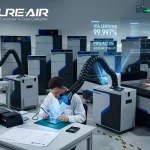
Achieving consistent, cost-effective air purification requires industrial-grade hardware and a proactive approach to system maintenance. Standard, commercial-grade ventilation units lack the structural durability needed to withstand the grueling demands of continuous manufacturing environments. For reliable operations, factories need heavy-duty systems built with robust multi-stage filtration architectures. The industrial systems designed by PURE AIR feature high-capacity pre-filters, carbon gas-phase modules, and certified HEPA media engineered to capture 99.97% of airborne micro-particles. This specialized design ensures that each filtration stage handles its targeted particle size efficiently, maximizing the service life of the primary HEPA filter.
Selecting the appropriate extraction system and establishing a predictable maintenance routine requires a detailed analysis of production volume, tool layouts, and chemical exposure. For businesses looking to enhance workplace safety, minimize machine downtime, and optimize filter replacement cycles, the engineering team at PURE AIR provides field-tested guidance and reliable equipment tailored to modern industrial demands.
To discover how our high-capacity systems can protect your automation investments and ensure regulatory compliance, contact ustoday for an expert consultation.