Do I Need a Fume Extractor for Soldering?
The rapid expansion of high-volume electronics assembly lines highlights a critical operational question for modern factory managers: is a dedicated solder fume extractor truly required for manual and automated production? In high-precision commercial facilities, soldering processes are indispensable for joining electronic components securely. However, the high temperatures required to melt solder wire and activate flux cores generate a dense stream of toxic smoke, fine dust particles, and irritating chemical gases. For industrial manufacturers, ignoring these processing emissions leads to severe legal penalties, reduced production efficiency, and employee health liabilities. Relying on advanced filtration solutions from experienced engineering partners like PURE AIR is essential to maintain full operational safety and high performance on the shop floor.
The Chemical Composition and Hazards of Soldering Smoke
Understanding the complex chemical structure of soldering emissions clarifies why a high-performance solder fume extractor remains an absolute operational necessity. Most standard electronic solders utilize rosin-core fluxes to strip away metal oxides and facilitate smooth solder flow during heating. Rosin is derived from natural pine resin, which contains colophony, a complex organic compound that decomposes under intense heat. This thermal breakdown releases gaseous chemical vapors, irritating organic acids, and dense particulate clouds. When an automated soldering station operates continuously without a dedicated solder fume extractor, these gaseous byproducts remain suspended in the factory air, creating a sticky residue that settles on surrounding machinery components.
Even as global electronics manufacturers adopt lead-free manufacturing initiatives, thermal processing still releases heavy metal sub-micron particles and ultrafine dust. These metallic fumes are incredibly small, often measuring less than 0.3 micrometers in diameter, allowing them to escape standard overhead warehouse ventilation units. Without localized source capture using an industrial-grade solder fume extractor, these dangerous sub-micron fragments spread quickly across assembly rooms. These fine dusts present a persistent threat to cleanroom parameters, component aesthetics, and long-term machinery precision.
Protecting Assembly Line Workers and Mitigating Health Liabilities
Industrial air quality directly influences employee health, assembly team morale, and adherence to shifting international workplace occupational health regulations. Prolonged, daily inhalation of unmitigated soldering emissions leads to serious, documented health consequences for factory personnel. The airborne colophony and synthetic vapors can trigger immediate eye irritation, intense coughing, and severe chest tightness. Over multi-year manufacturing shifts, continuous exposure often causes workers to develop permanent occupational asthma, chemical hypersensitivity, and serious lung function decline. Utilizing an efficient solder fume extractor at every workstation captures these toxic fumes directly at the soldering iron tip, removing the hazard from the breathing zone of the operators.
A clean, comfortable, and odorless workspace environment contributes directly to higher employee retention rates and improved daily assembly focus. When toxic smoke and pungent chemical smells permeate an electronics assembly plant, operator fatigue increases, leading to a rise in manual assembly errors. Deploying high-efficiency filtration units keeps the ambient air pure, boosts workplace morale, and drastically cuts down on absenteeism caused by respiratory issues. Investing in a solder fume extractor shows a clear commitment to corporate welfare, which attracts and retains top manufacturing talent.
Maximizing First-Pass Product Yields and Guarding Machinery
The operational impact of airborne soldering debris goes far beyond employee safety, directly altering the long-term profitability of commercial manufacturing systems. Modern printed circuit boards feature micro-vias and dense component spacing that are highly sensitive to airborne particulate contamination. The sticky tar and chemical soot generated by cooling flux vapors can settle onto unpopulated boards and wet solder joints. This thin, invisible film of chemical residue can create unexpected insulation barriers, interfere with signal paths, or cause early electrical short circuits. Running a robust solder fume extractor ensures that these sticky particles are pulled away instantly, protecting fine electronic traces and maximizing first-pass production yields.
Automated pick-and-place robots, high-speed linear actuators, and optical inspection cameras represent massive capital investments for electronics manufacturers. Solder flux smoke can quickly combine with factory lubricants, turning into an abrasive, gummy paste that coats precision guide rails and robotic joints. This localized grime increases mechanical resistance, accelerates equipment wear, and induces minor positioning drifts that ruin automated accuracy. Consistent localized purification via a heavy-duty solder fume extractor protects these delicate mechanical components, lowering machine breakdown frequencies and reducing factory maintenance costs.
Overcoming Industrial Scale Air Purification Challenges
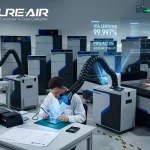
Choosing a generic air filtration system often fails to solve the rigorous demands of large-scale, automated industrial electronics manufacturing. Industrial electronics assembly requires multi-layered purification engineering to handle both large solid particles and gaseous volatile compounds simultaneously. Advanced air systems developed by PURE AIR employ a structural multi-stage configuration, integrating durable pre-filters, carbon chemical gas-phase modules, and certified HEPA media. This specific arrangement allows the primary solder fume extractor hardware to capture up to 99.97% of fine particles down to 0.3 micrometers while neutralizing irritating smells. This balanced loading ensures that each filtration level lasts longer, minimizing operational filter replacement costs.
International environmental protection agencies and global B2B buyers enforce strict threshold limit values for factory emissions and cleanroom safety. Facilities running production lines without certified, high-performance extraction systems risk facing severe regulatory fines, mandatory line shutdowns, and corporate exclusion from international contracts. Utilizing a verified, industrial-grade solder fume extractor guarantees that indoor plant emissions stay consistently within legal limits, securing necessary ISO certifications and building long-term trust with global commercial buyers.
Selecting the Ideal Fume Extraction Strategy with PURE AIR
Optimizing factory air quality requires deploying reliable extraction machinery that is tailored to specific factory layouts, production volumes, and manufacturing speeds. Standard commercial air scrubbers lack the deep vacuum pressure required to draw heavy soldering smoke out of dense automated production enclosures. For manufacturing operations looking to improve product quality, secure regulatory compliance, and extend automated machine life, the expert team at PURE AIR provides robust, field-tested systems built for rapid production integration.
To learn more about how a customized solder fume extractor can optimize your specific assembly workflow and protect your automation investments, contact us today for a professional engineering consultation.