What are the Challenges of 3D Printing in Fume Extracting?
Additive manufacturing has transitioned from a prototyping tool into a core technology for industrial production lines. Businesses leverage 3D printing to create highly intricate geometries, reduce material waste, and accelerate development cycles. However, as industrial installations scale up, factory managers face significant environmental and operational challenges. The thermal processing of plastics, resins, and metal powders releases a complex cocktail of airborne contaminants into the workplace. Implementing high-capacity air purification engineering from recognized industry experts like PURE AIR is no longer a luxury but an absolute operational necessity. Managing these complex emissions requires specialized extraction technology capable of handling sub-micron debris and hazardous gas simultaneously to protect operator health and maintain sensitive machinery.
The Hidden Diversity of Additive Manufacturing Emissions
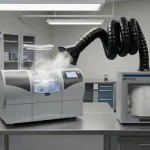
One of the greatest difficulties in managing additive manufacturing air quality is the sheer variety of pollutants generated across different printing technologies. Industrial facilities rarely use just one material, meaning their extraction equipment must be highly versatile to prevent workspace contamination. Fused Deposition Modeling (FDM) and Stereolithography (SLA) processes rely on heating polymers or curing liquid resins with ultraviolet light. This thermal and chemical alteration releases high concentrations of volatile organic compounds (VOCs) and dangerous ultrafine particles into the ambient air. These microscopic emissions remain suspended in the factory environment indefinitely, bypassing standard building ventilation. To protect personnel from breathing these invisible chemical vapors, facilities must install a dedicated 3D printer fume extractor at every active print station, ensuring that hazardous gases are completely neutralized before they can disperse across the broader production floor.
Selective Laser Melting (SLM) and Direct Metal Laser Sintering (DMLS) present entirely different environmental and safety challenges. These high-end processes use high-powered lasers to fuse fine metal powders, which generates an incredibly fine, reactive metallic soot. This byproduct is often highly combustible and presents a severe risk of dust explosions if allowed to accumulate in standard ductwork. Consequently, a standard ventilation loop cannot be used; instead, a specialized, explosion-resistant 3D printer fume extractor must be deployed to capture reactive metal dust safely, prevent hazardous accumulation, and maintain a stable manufacturing environment.
Maintaining Consistent Airflow Without Disrupting Print Quality
In industrial 3D printing, the extraction process cannot simply pull air at maximum velocity, as improper airflow management can ruin the structural integrity of the parts being printed. Many industrial polymers require precisely controlled temperature enclosures to prevent warping, delamination, and structural shrinkage during the print cycle. If an active 3D printer fume extractor pulls air too aggressively, it can alter the ambient temperature inside the build chamber. This localized cooling induces thermal shock in the layered material, leading to immediate part deformation and costly batch rejections. Extraction systems must therefore feature adjustable, highly accurate airflow controls to remove toxic smoke without disturbing the delicate internal thermal equilibrium of the printing machinery.
Industrial metal 3D printers rely on filling the build chamber with inert gases, such as argon or nitrogen, to prevent metal oxidation during laser sintering. A major challenge for any 3D printer fume extractor operating in this environment is filtering out microscopic soot without exhausting the expensive inert gas supply. Advanced industrial extraction units must be engineered to operate within a sealed, closed-loop configuration. This layout allows the system to continuously scrub sub-micron metal particles out of the air while safely returning the purified inert gas back into the print chamber, maintaining strict atmospheric purity and minimizing operating costs.
Overcoming Rapid Filter Saturation and Maintenance Overhead
The physical characteristics of 3D printing emissions cause standard commercial filtration media to clog at an accelerated rate, driving up operational overhead. Plastic and resin printing processes release sticky, oily chemical vapors that cool down as they travel through extraction ductwork. These condensable vapors turn into a tacky residue that coats the interior surfaces of the filtration unit and settles directly onto primary filter elements. This sticky coating glues fine dust particles to the filter fibers, forming an impenetrable barrier that restricts system airflow rapidly. Without a robust multi-stage 3D printer fume extractor designed by specialists like PURE AIR to handle condensable hydrocarbons, expensive high-efficiency filters will saturate prematurely, requiring frequent, costly manual replacements.
Industrial additive manufacturing lines frequently run unassisted over weekends and through night shifts to maximize production throughput. If a filtration system loses suction power due to sudden filter blinding mid-print, the resulting buildup of haze can block the printing laser or ruin the surface finish of the components. Modern factories require an industrial-grade 3D printer fume extractor equipped with continuous differential pressure monitoring. This technology provides advanced warning of filter saturation, ensuring maintenance teams can schedule element changes between production cycles rather than suffering catastrophic mid-shift interruptions.
Driving Regulatory Compliance and Commercial Success
Implementing proper air management hardware is not merely an operational preference; it is a critical requirement for regulatory compliance and business profitability. In powder bed fusion systems, the dense smoke generated by laser sintering can drift across the path of the primary laser beam. This particulate haze scatters the laser energy, reducing the focus and power delivered to the metal powder bed, which leads to weak structural bonds and poor material density. Furthermore, uncollected soot can settle onto the protective lens of the laser, causing thermal cracking under extreme heat. Utilizing a reliable 3D printer fume extractor keeps the optical path pristine, preserving laser power consistency and significantly lowering part scrap rates.
Occupational health organizations enforce strict permissible exposure limits regarding airborne plastic particles, metal dusts, and chemical VOCs. Operating a production facility without certified air cleaning hardware exposes a business to severe regulatory fines, mandatory operational shutdowns, and long-term legal liabilities. Installing an industrial-grade 3D printer fume extractor guarantees that indoor air emissions consistently meet regional safety standards, safeguarding the workforce from chronic respiratory illnesses and reinforcing corporate compliance profiles.
Strategic Air Management with PURE AIR Solutions
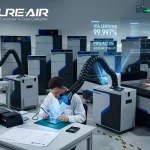
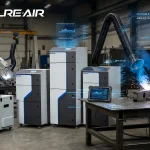
Overcoming the unique challenges of additive manufacturing emissions requires heavy-duty air purification hardware engineered specifically for rigorous industrial environments. Standard commercial air scrubbers lack the multi-stage depth required to handle sticky polymer vapors and ultra-fine metal dust simultaneously. The advanced extraction systems developed by PURE AIR feature heavy-duty structural pre-filters, high-capacity carbon gas-phase modules, and certified HEPA media. This rugged construction ensures the equipment captures 99.97% of airborne micro-particles down to 0.3 micrometers, maintaining pristine air quality through demanding manufacturing shifts.
Every industrial facility operates with distinct machinery configurations, material types, and floor layouts. Optimizing your workspace requires matching extraction airflow rates precisely to your specific production volumes. For additive manufacturing enterprises looking to optimize production yields, extend laser equipment life, and secure complete workplace compliance, the technical engineering team at PURE AIR provides field-tested systems tailored for seamless factory integration.
To learn more about how our high-capacity 3D printer fume extractor technology can safeguard your automated production investments, contact us today for an expert consultation.