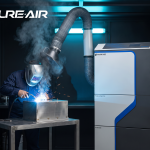
Operating industrial equipment with open doors or windows creates uncontrolled airflow rather than structured ventilation. Passive air movement relies on atmospheric pressure differences, which fluctuate unpredictably throughout operational shifts. Deploying an engineered dust and fume extraction system directly at processing sources prevents hazardous thermal plumes from dispersing across open facility floors.
Natural air currents disperse light smoke particles across rafters instead of exhausting them outside safely. Uncontrolled cross-drafts push sub-micron aerosols back into worker breathing zones, exposing operators to continuous chemical contamination. Relying on open bay doors leaves workplace air quality vulnerable to changing outdoor weather conditions.

Fluid Dynamics and Limitations of Natural Cross-Drafts
Air exchange rates achieved through passive openings fail to clear dense industrial contaminants efficiently. While large doors allow fresh outdoor air to enter, incoming air currents dilute toxic fumes rather than capturing them at origin points. Dilution merely spreads particulate matter into adjacent administrative offices and clean assembly zones.
High-density thermal plumes created by cutting or welding rise faster than general cross-ventilation can move air laterally. Without forced mechanical exhaust, heavy aerosol loads accumulate near high ceilings before cooling and settling back onto work surfaces. At PURE-AIR, we measure room turnover rates to highlight the limits of passive ventilation.
Physics of Capture Velocity at Emission Origin Points
Capturing thermal emissions before they enter breathing zones requires generating precise face velocity at intake hoods. Suction speed must overcome natural thermal buoyancy and ambient air turbulence created by surrounding machinery. Operating a high-capacity air purifier for industries provides the suction power needed to pull fine particles away from active torches.
Suction force degrades rapidly as distance between an intake hood and an emission point increases. Doubling capture distance reduces effective face velocity dramatically, allowing hot gases to escape into open shop air. Engineered extraction hoods preserve high velocity vectors close to active welding arcs or laser nozzles.
Airflow Organization and Internal Air Distribution Patterns
Proper airflow organization directs contaminated airstreams into filtration channels while delivering replacement air smoothly. Poorly planned ventilation layout creates turbulent eddies, trapping stagnant odor pockets near overhead cranes and operator stations. Structured air distribution routes clean supply air behind technicians, driving fumes forward into collection hoods.
Balancing positive and negative pressure zones within factory bays prevents hazardous smoke from leaking into clean areas. Operating extraction equipment under negative pressure contains volatile organic compounds inside sealed ductwork. Controlled air distribution pathways protect personnel from exposure to floating metallic dust.
Health Hazards of Uncontrolled Fume Dispersion
Allowing sub-micron metallic oxides and chemical gases to drift freely throughout production halls poses severe health risks. Fine particulate matter stays suspended in breathing zones for extended periods, penetrating deep into human lung tissue. Invisible gases generated during high-heat processing remain hazardous long after visible smoke clears.
Accumulated surface dust on electrical panels and optical equipment causes premature machinery breakdowns and electrical shorts. Uncontrolled particulate dispersion damages delicate workpieces during sensitive coating or assembly tasks. Systematic containment of airborne pollutants protects both worker health and processing hardware.
Engineered Extraction as the Effective Technical Solution
Resolving workshop air contamination requires implementing targeted, source-capture extraction hardware rather than passive ventilation. Installing a multi-stage dust and fume extraction system isolates fine particulate matter and toxic gases simultaneously. Source capture prevents thermal plumes from expanding into general plant air.
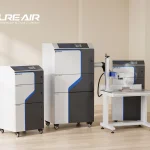
The graded purification path of primary pre-filter, H14 high-efficiency filter and impregnated activated carbon effectively intercepts coarse metal debris, ultra-fine oxide aerosols and corrosive solvent vapors in sequence. PURE-AIR mature product lines including the PA-FS series and PA-D series adopt this multi-stage structural design, with high-static-pressure fan configuration matching thermal plume buoyancy force to lock in capture velocity at the nozzle. Modular unit design supports on-site combination for single-station flexible production and centralized pipeline overall ventilation transformation, realizing a full replacement for inefficient natural ventilation.
Continuous Filter Status Monitoring for Operational Reliability
Filter replacement cycles depend heavily on daily processing frequency, material types, and pollutant concentrations. Operating a specialized air purifier for industries equipped with filter status monitoring allows operators to know exactly when cartridges require replacement. Real-time pressure tracking prevents unexpected airflow drops during critical shifts.
Saturated filter elements create internal static resistance, reducing face velocity at capture hoods and wasting electrical power. Intelligent pressure sensors detect media loading before airflow drops below safety thresholds. Timely cartridge replacement protects internal blowers while preserving consistent suction efficiency.
Tailoring Extraction Systems to Specific Material Loads
Equipment selection relies on analyzing laser power output, cut kerf dimensions, substrate material composition, and daily run times. Heavy metal processing generates high particulate volumes that demand high static pressure blowers like our PA-FS800 series. Matching extraction capacity to actual emission rates prevents premature filter blinding.
Specialized process lines handling technical ceramics, printed circuit boards, or photovoltaic panels generate fine toxic gases. Modular setups like our PA-D1600 model deliver high suction pressure up to 12000 Pa, capturing dense fumes efficiently. Sizing extraction systems properly supports reliable operation across continuous industrial shifts.
Source-Locked Mechanical Ventilation Replaces Passive Air Exchange
Passive ventilation relying on natural wind and temperature difference cannot form stable pollutant containment, inevitably leading to widespread fume diffusion, occupational health risks and equipment contamination. Source-oriented mechanical extraction builds directional negative pressure airflow to trap pollutants before they spread.
Multi-stage graded filtration and real-time filter condition monitoring sustain long-term stable purification performance. We at PURE-AIR conduct on-site working condition assessment, airflow calculation and customized equipment configuration to help manufacturers abandon outdated natural ventilation and build stable, compliant workshop air quality control systems.