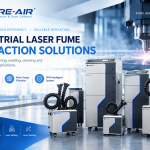
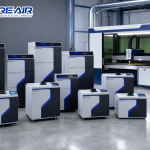
Not every laser workstation needs the same fume extraction system. A compact marking machine, an electronics production line, and a high-volume industrial process have different requirements for airflow, filtration, space, and maintenance. Selecting the right equipment means matching the extractor to the application rather than simply choosing the largest or most powerful model.
PURE-AIR offers industrial fume extraction solutions for laser marking, coding, cutting, and other manufacturing applications. Here are four practical factors to consider before investing in a system.
1. Match Equipment Size to Your Workspace
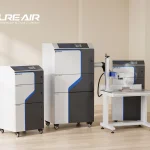
A desktop laser fume extractor or benchtop laser fume extractor can be a practical choice for compact workstations where floor space is limited. PURE-AIR’s F-Series includes compact models designed for low-volume laser marking and coding applications.
For example, the PA-F250s and PA-F350s offer rated airflow capacities of 250 m³/h and 350 m³/h, respectively. Their compact dimensions make them options worth evaluating for suitable single-station applications. The final choice should depend on the process, extraction distance, and required airflow.
For larger or more demanding marking operations, the PA-DS500i laser fume extractor is another option to consider. PURE-AIR lists this model with 500 m³/h airflow, 10,000 Pa negative pressure, and 1.1 kW rated power. These specifications provide a useful starting point when comparing equipment for a particular production environment.
2. Evaluate Performance and Energy Consumption
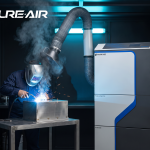
A powerful laser fume extractor should provide suitable extraction performance under actual operating conditions. Higher airflow alone does not guarantee better results: the system must also provide sufficient negative pressure for the connected ducting, extraction arm, and source-capture arrangement.
When comparing an energy saving laser fume extractor, consider rated power alongside airflow, operating hours, and process requirements. A system that is appropriately sized for its application can help avoid selecting equipment that is unnecessarily large for the task.
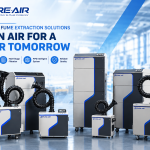
PURE-AIR offers different models and configurations, allowing buyers to compare specifications before making a decision. Always check the individual model’s technical data rather than assuming that every unit shares the same performance characteristics.
3. Plan for Filter Maintenance
Regular laser fume extractor maintenance helps keep equipment operating as intended. Filter life depends on the material being processed, contaminant concentration, production frequency, and operating conditions.
PURE-AIR laser marking solutions use filtration configurations that may combine pre-filtration, HEPA filtration, and activated carbon, depending on the selected model. These stages address different contaminants, including fine particles and certain odors or gaseous compounds.
Before purchasing, ask about filter replacement intervals, replacement costs, and filter-status monitoring features. Following the recommended maintenance schedule can make ongoing operation easier to manage.
4. Find the Right Supplier for Your Application
Searching for a laser fume extractor near me may help identify local suppliers, but proximity should not be the only consideration. Buyers should also evaluate technical support, product specifications, replacement-filter availability, and the supplier’s understanding of the application.
If you are comparing options for a top laser fume extractor, start by preparing your laser type, processed material, number of workstations, operating hours, and installation constraints. This information helps narrow the choices to equipment that fits your actual needs.
Request a PURE-AIR Recommendation
The right extraction system should balance workspace, performance, filtration, and long-term operating requirements. PURE-AIR provides solutions for different industrial applications and equipment configurations.
Contact PURE-AIR today with your process details to discuss a suitable model and request a quotation. Our team can help you compare available options and identify a solution for your production requirements.