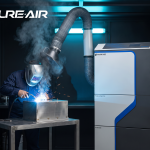
Uncontrolled smoke escaping from capture boundaries often points to breakdowns in local airflow dynamics. Thermal plumes generated by laser cleaning and marking rise rapidly, easily breaching weak suction boundaries. At PURE-AIR, our engineering team analyzes fluid behavior to understand why a fume extraction machine might lose containment during active production.
Buoyant thermal currents carry particulate matter upward at high speeds during high-heat laser surface treatments. When suction forces at intake hoods fail to match rising plume momentum, smoke spills around hood edges. Proper containment requires generating sufficient capture velocity directly above emission zones.
Impact of Capture Distance on Intake Velocity
Intake velocity drops exponentially as the physical gap between emission sources and capture hoods expands. Doubling the distance from a laser nozzle reduces effective suction velocity at hood boundaries by nearly seventy-five percent. Positioned too far away, capture hoods lose the kinetic energy required to draw rising smoke plumes into collection channels.
Placing suction hoods within one duct diameter of processing zones drastically improves contaminant capture. Close placement stops high-velocity smoke vectors before ambient factory air disperses them across work cells. Adjusting position supports that thermal plumes remain contained inside primary exhaust pathways.
Cross Draft Interference Across Workshop Spaces
Ambient cross drafts from open bay doors, cooling fans, or moving machinery disrupt local suction fields around capture hoods. Lateral air currents exceeding 0.5 meters per second push rising smoke plumes away from hood openings. Disrupted thermal plumes bypass capture zones, allowing fine metallic dust and chemical vapors to spread across production floors.
Installing physical side baffles or flexible curtains shields intake boundaries from ambient cross drafts. Baffles direct air currents smoothly into extraction hoods while blocking disruptive lateral drafts. Our technical staff at PURE-AIR designs custom hood shielding to stabilize suction fields in busy industrial workshops.
Geometric Hood Design and Enclosure Flanges
Unflanged round hoods pull air equally from all directions, including clean space behind the hood face. Drawing air from behind reduces effective suction velocity at target processing areas. Adding outer perimeter flanges redirects airflow suction forward, focusing intake energy directly on rising thermal smoke.
Tapered hood transitions prevent internal air turbulence and static pressure losses at duct connection points. Custom hood geometry matched to workpieces helps prevent dead zones where fine smoke accumulates. Integrating well-designed hoods on a fume extraction machine supports effective smoke capture during laser processing.
Static Pressure Requirements in Narrow Duct Channels
Narrow flexible hoses and complex duct bends create high internal static resistance against moving air. Inadequate static pressure starves capture hoods of volumetric airflow, allowing smoke to spill past hood boundaries. Operating a fume extraction equipment setup requires matching fan static pressure to internal duct friction losses.
Laser cleaning and marking generate fine aerosol particles that demand strong negative static pressure to move through long hoses. High static pressure blowers pull smoke through restrictive ducts without losing capture velocity. Sizing blowers to match system resistance keeps suction steady across extended work shifts.
Matching System Capacity to Laser Processing Variables
Selecting extraction hardware demands evaluating laser power, scan width, substrate material composition, and daily processing time. High-power laser cleaning on painted or rusted surfaces yields dense smoke volumes requiring high airflow capacity. Under-sized extraction systems flood quickly, causing smoke to spill into worker breathing zones.
Equipment configurations are designed with sufficient static pressure and airflow capacity to capture dense smoke directly at the source. Matching blower performance to material processing rates helps prevent thermal plume escape and maintain effective contaminant control. Tailoring extraction hardware to specific process requirements supports cleaner indoor air quality throughout production areas.
Multi-Stage Filtration Strategies for High-Duty Lines
Dense smoke generated by surface cleaning loads filter media rapidly, increasing internal static pressure over time. Rising pressure drops blower volumetric airflow, gradually reducing capture velocity at intake hoods. Multi-stage filtration arrays protect primary cartridges by trapping heavy particulate matter in dedicated pre-filters.
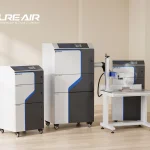
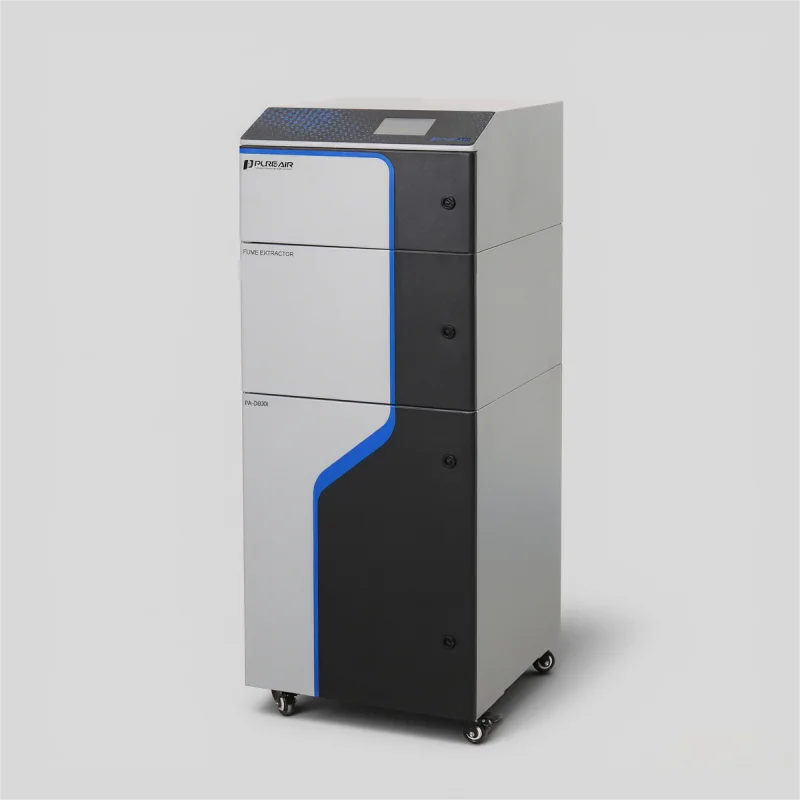
Sequencing pre-filters, intermediate synthetic layers, and final HEPA media minimizes premature filter surface blinding. Equipment series like our DFS Series and PA-DFS800 models utilize multi-tier chambers to handle airflow capacities up to 800 m³/h smoothly. Layered filter beds maintain stable suction velocity across demanding laser processing operations on a fume extraction machine.
Integration of Smart Monitoring in Modern Facilities
Intelligent diagnostic sensors monitor internal static pressure differential and airflow rates in real time. Visual screen alerts notify operators when filter loading threatens to drop capture velocity below required safety thresholds. Timely filter servicing helps prevent airflow degradation before smoke escapes capture hoods during active processing.
Connecting extraction hardware to automated machine controls synchronizes blower speed with laser activation cycles. Automated speed adjustments maintain required face velocity whenever active processing begins. Deploying modern fume extraction equipment units like our DFS-i and PA-DFS2400 models preserves clean workshop air across automated production bays.
Conclusion
Preventing smoke spillover at extraction hoods requires managing capture distance, neutralizing cross drafts, refining hood geometry, and providing adequate static pressure. Deploying specialized air purification hardware isolates thermal plumes and hazardous gases directly at laser emission sources. Through technical evaluation and engineered equipment at PURE-AIR, manufacturing facilities maintain clean, compliant, and efficient production environments.