Dark soot, fine carbon residue, and metallic dust frequently settle across surfaces even in facilities with active roof fans or wall exhausts. General ventilation diluted air currents fail to capture localized thermal plumes before particulates disperse into surrounding shop air. Installing the best industrial air purifier right at emission sources prevents buoyant smoke vectors from spreading fine dark residue throughout manufacturing bays.
Escaping particulates occur when suction velocity drops below thermal plume rise speeds. As hot gases rise, cross-drafts from doorways or cooling fans break up rising smoke streams, dispersing sub-micron carbon soot into high-ceiling spaces. Settling gradually over hours, these floating particles create dark film layers across machinery, workbenches, and finished goods.
Principles Governing Capture Efficiency at Emission Boundaries
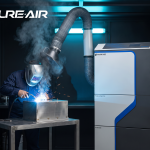
Controlling fine airborne particulate matter depends directly on maintaining high capture efficiency right at the generation boundary. Position, angle, and distance of intake hoods dictate whether thermal fumes enter filter channels or spill into open air. Even slight misalignments allow high-velocity smoke streams to bypass suction boundaries.
Increasing intake distance exponentially degrades suction power according to standard fluid dynamics laws. Doubling the distance between a welding torch or laser head and a hood reduces effective capture velocity by up to seventy-five percent. Our technical team at PURE-AIR designs specialized capture hoods to maintain focused airflow vectors near processing zones.
Pressure Differential Dynamics: Positive Versus Negative Pressure
Building pressure balances heavily influence how airborne contaminants travel inside industrial workshops. Facilities operating under positive internal pressure push warm, dust-laden air outward toward clean assembly zones or administrative offices. Conversely, uncalibrated negative pressure zones create turbulent drafts that pull settling dust off rafters back into active breathing spaces.
Maintaining controlled negative pressure inside extraction enclosures keeps dark particles contained within filtration channels. Properly balanced duct networks prevent dust leakage from unsealed seams, joints, and hopper collection boxes. Equipment setups like our PA-FS800 series utilize high negative suction pressure up to 8000 Pa to pull heavy particulate loads through filtration circuits securely.
Duct Velocity and Particulate Transport Losses
Low air transport speed inside horizontal duct runs causes dark metallic dust and carbon soot to settle along pipe floors. Over time, internal dust accumulation reduces effective duct diameters, creating static pressure losses and choking overall suction. Reduced duct airflow allows captured particles to drop out of suspension before reaching primary filter banks.
Maintaining minimum duct velocities around 15 to 20 meters per second prevents internal particulate settling during continuous operation. Smooth duct bends and sealed flanges minimize internal friction losses, preserving airflow energy along long extraction lines. At PURE-AIR, we calculate precise duct parameters to support consistent particle transport.
Evaluating Filtration Media and Leakage Pathways
Sub-micron dark soot easily passes through standard coarse filter bags, recirculating fine carbon back into shop air. Unsealed filter mountings, damaged gaskets, or torn media pleats create bypass pathways where raw dust escapes purification chambers. Inspecting internal seals helps prevent fine particulate leakage around filter frames.
High-efficiency media like HEPA H14 or e-PTFE membrane cartridges isolate sub-micron dark particles with 99.99% efficiency. Deploying an industrial strength air purifier equipped with multi-stage filtration traps fine carbon smoke before clean air recirculates. Equipment series like our D-i Series incorporate sealed filter tracks to prevent internal air bypass.
System Sizing and Blower Calibration Strategies
Improperly sized extraction blowers fail to maintain required capture velocities during heavy processing cycles. Matching fan curves, motor horsepower, and static pressure capabilities to actual shop emission rates reduces thermal plume escape. Calibrating blower capacity against total duct resistance keeps suction stable across multiple active workstations.
Variable frequency drives adjust motor speeds automatically to compensate for gradual filter loading over multi-shift operations. Automated air volume compensation keeps intake velocities constant, preventing dark dust from escaping capture hoods as filter resistance climbs. Proper system calibration extends filter element service life while maintaining high air purity.
Maintenance Routines to Eliminate Background Dust Buildup
Preventing dark dust accumulation requires regular inspection of capture hoods, pulse-jet cleaning mechanisms, and dust hoppers. Emptying collection bins regularly prevents particulate re-entrainment into intake air streams. Automated pulse-jet cleaning systems blast compressed air through cartridge pleats to clear surface dust layers before static pressure spikes.
Connecting extraction hardware to digital monitoring platforms tracks real-time differential pressure and filter health. Monitoring systems alert maintenance personnel before airflow drops cause particulate spillage. Deploying a well-maintained best industrial air purifier keeps plant floors clear of persistent dark dust accumulation.
Conclusion
Resolving persistent dark dust accumulation requires balancing intake hood geometry, duct air velocity, pressure dynamics, and high-efficiency filtration media. Integrating an industrial-strength air purifier equipped with e-PTFE membrane filter cartridges and HEPA filtration helps capture sub-micron carbon particles before they spread throughout the facility.
At PURE-AIR, we combine application-specific system design with technical consultation to help manufacturers select extraction solutions tailored to their production processes. Whether upgrading an existing dust collection system or planning a new installation, our team works with customers to improve contaminant capture, maintain cleaner workplaces, and support long-term operational performance.