Air Quality Challenges in Modern Manufacturing Facilities
The rapid evolution of modern manufacturing technologies has significantly increased production speeds and component precision across global supply chains. Advanced processes such as high-powered laser cutting, heavy-duty metal processing, automated electronics soldering, and industrial 3D printing introduce severe environmental challenges to the shop floor. These sophisticated operational activities generate massive volumes of invisible, high-concentration airborne contaminants that cannot be managed by standard ventilation alone. For commercial operators, ignoring these sub-micron threats jeopardizes product quality, spikes machinery maintenance expenses, and compromises employee respiratory safety. Addressing these critical challenges requires a deep engineering understanding of industrial pollution and the strategic implementation of heavy-duty industrial fume extraction systems from industry leaders like PURE AIR.
The Complex Composition of Industrial Airborne Contaminants
Industrial air pollution is rarely a single type of waste, but rather a hazardous mixture of solid particulates and toxic gases generated simultaneously during production. Mechanical cutting, high-speed milling, and grinding processes shear raw materials apart, sending cloud arrays of abrasive metallic dust and coarse particulates floating through the factory air. These solid particles vary in size, with larger pieces dropping nearby while smaller micro-dust stays suspended indefinitely in ambient air currents. Without proper source capture and automated industrial fume extraction, these floating abrasive particles migrate throughout the facility, finding their way into sensitive electronics, settling on high-speed robotic actuators, and wearing down expensive machinery components prematurely.
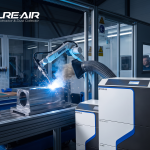
Thermal cutting processes, including laser cutting, automated electronics soldering, and plastic welding, create completely different, highly complex air purity hazards that demand consistent air treatment. The intense heat of industrial lasers vaporizes substrates, creating dense chemical smoke packed with sticky sub-micron carbon soot, heavy metal particles, and corrosive gases. Similarly, standard wave soldering and adhesive curing release dangerous volatile organic compounds and pungent odors into the workspace. Managing these complex thermal emissions requires localized, multi-stage industrial fume extraction setups that capture chemical gases and micro-debris at the exact micro-second they form, ensuring ambient safety.
The Operational Consequences of Inadequate Extraction Hardware
Allowing hazardous smoke, volatile chemical fumes, and abrasive micro-particles to accumulate within a production plant creates severe operational risks for commercial operations. In high-precision electronics assembly, medical device production, and optical manufacturing, microscopic airborne dust acts as a catastrophic contaminant. Floating debris settles onto unpopulated circuit boards, causing electrical shorts, trace misalignments, and immediate inspection failures that severely reduce first-pass production yields. Furthermore, when abrasive industrial dust mixes with machinery lubricants, it turns into a highly destructive grinding paste that accelerates mechanical wear on linear guide rails and precise robotic bearings, increasing downtime and spiking overhead expenses unless controlled by continuous industrial fume extraction technology.
Laser engraving, cutting, and welding machinery depend on pristine optical paths to deliver consistent energy pulses to target substrates. The dense smoke and volatile oils generated during thermal cutting naturally migrate toward the laser’s protective focal lens if left uncollected. This residue bakes directly onto the expensive glass surface under extreme operating temperatures, causing beam distortion, positioning drift, and eventual lens cracking. Integrating dedicated industrial fume extraction hardware draws these sticky sub-micron deposits completely away from vulnerable laser heads, preserving beam accuracy, minimizing automated equipment damage, and protecting valuable machinery investments over multi-shift operations.
Navigating Changing Occupational Health and Environmental Regulations
Controlling factory air quality is a strict legal and organizational mandate affecting modern industrial operations, directly shaping corporate sustainability profiles. Thermal processing emissions contain complex chemical formulas, including lead micro-particles, synthetic flux residues, and rosin core decomposition products. Prolonged worker exposure to these airborne toxins leads to acute eye irritation, persistent headaches, and serious chronic occupational illnesses like occupational asthma or permanent lung damage. Implementing highly efficient industrial fume extraction units removes these hazards from worker breathing zones, protecting employee health, fostering positive workplace morale, and drastically reducing costly corporate liability claims.
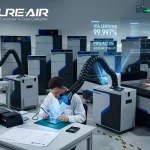
In addition to health risks, environmental agencies worldwide have established strict threshold limit values for indoor factory environments and external workplace emissions. Manufacturing facilities that operate without certified air purification setups risk severe financial penalties, immediate mandatory shutdowns, and devastating long-term reputational damage among B2B clients. Utilizing verified industrial fume extraction setups engineered by PURE AIR ensures that factory air is thoroughly scrubbed of 99.97% of airborne micro-particles down to 0.3 micrometers, allowing facilities to achieve full legal compliance and pass stringent cleanroom certification checks.
Strategic Air Purification Deployment with PURE AIR Solutions
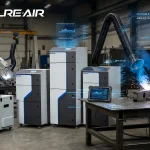
Overcoming the multifaceted air purity challenges of modern automated assembly lines demands heavy-duty hardware specifically engineered for continuous commercial workloads. Basic commercial ventilation structures lack the necessary structural filtration depth required to safely capture and neutralize complex manufacturing debris. Reliable industrial operations depend on advanced multi-stage extraction setups that separate particles by size across multiple specialized layers. The high-performance systems designed by PURE AIR combine heavy-duty structural pre-filters, high-capacity carbon gas-phase modules, and certified HEPA media. This specific engineering strategy allows the filtration equipment to capture microscopic particulates and irritating chemical odors simultaneously, providing comprehensive protection across heavy production shifts.
Every modern industrial plant operates with distinct tool layouts, floor constraints, production volumes, and unique material compositions. Optimizing factory air management requires selecting exact airflow rates and localized extraction configurations tailored to specific machinery lines. For manufacturing enterprises looking to improve production efficiency, protect automation assets, and secure workplace safety, the technical engineering team at PURE AIR provides robust, field-tested systems designed for seamless integration.
To learn how specialized industrial fume extraction systems can enhance your specific manufacturing workflow, contact us today for an authoritative consultation.