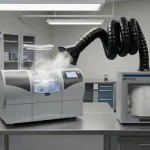
A printing-room exhaust system has to do more than simply move contaminated air outside. It needs to capture fumes close to the source, maintain sufficient airflow through the ductwork, and remove both airborne particles and gas-phase VOCs before the air is discharged.
How to deal with exhaust in printing rooms? Simply installing an exhaust fan is rarely enough to control VOC emissions. Effective control depends on where fumes are generated, how efficiently the exhaust system captures and transports them, and whether the selected filtration can handle the specific contaminants produced during printing.
What Are VOCs and How Are They Generated During Printing?
VOCs are carbon-based chemicals that evaporate into the air at room temperature. In a printing room, they come mainly from solvent inks, fountain solutions, coatings, and the solvents used to clean print heads and rollers.
Different processes release different amounts. For example, one peer-reviewed study found that offset printing produced high total VOC levels largely because print heads were cleaned with solvent, and the effect was worse in a small room with poor exhaust.
Common VOC and particulate sources in printing include:
- Solvent-based and UV inks, which release VOCs and acrylate monomers
- Fountain solutions and coatings used during the press run
- Cleaning solvents for heads, blankets, and rollers
- Fine paper dust and ink mist, which add PM2.5 particles to the air
What Health and Compliance Risks Do VOCs Create?
Poor VOC control creates problems beyond unpleasant odors. Workers may be exposed to solvent vapors, while airborne contaminants can also affect production conditions and create compliance issues for the facility.
Long-term VOC exposure is linked to breathing problems and other health effects, and it raises clear compliance duties for the employer. Regulators such as OSHA and the EPA set limits on workplace exposure and on emissions, and these limits keep getting tighter.
One point matters for planning. OSHA sets exposure limits for many single chemicals, not one blanket limit for “total VOCs”. Therefore, you must control each hazardous compound your inks and solvents contain, rather than aim for a single number.

How Can You Design an Exhaust System That Controls VOCs in Printing Rooms?
Effective exhaust in printing rooms depends on capturing fumes close to the source, maintaining sufficient airflow through the ductwork, and selecting a fan that can handle the system’s total resistance. These factors are closely linked, so a problem with us can reduce the performance of the entire system.
Should You Use Local Exhaust or General Dilution Ventilation?
For most printing rooms, local exhaust ventilation (LEV) is the better first choice because it captures fumes before they reach the worker’s breathing zone. General dilution ventilation thins the fumes after they have already spread through the room.
The table below compares the two approaches so you can match them to your process.
| Factor | Local Exhaust Ventilation (LEV) | General Dilution Ventilation |
| How it works | Captures fumes at the source, before they spread | Mixes and thins fumes across the whole room |
| Best for | High or concentrated VOC sources such as ink and cleaning solvents | Low, spread-out background emissions |
| Worker protection | High; fumes never reach the breathing zone | Lower; fumes pass through the room first |
| Running cost | Lower airflow, so less energy to heat or cool make-up air | Higher airflow and higher energy use |
In fact, many printing rooms use both. LEV handles the strong sources such as the press and the cleaning station, while general ventilation manages the lighter background air. However, LEV should always do the heavy lifting.
What Capture Velocity and Airflow Do Printing Rooms Need?
The required capture velocity depends on the type of fume, release conditions, hood design, and applicable ventilation standards. In many applications, the airflow is needed to be sufficient to capture contaminants at their source before they disperse into the surrounding workspace.
The distance between the hood and the emission source also affects the airflow needed for effective capture. As the hood moves farther away, the airflow reaching the source weakens rapidly, so the system may require a higher airflow rate to maintain the same capture performance.
Keeping the hood close to the ink or solvent source can therefore improve capture efficiency, while cross-drafts from doors, fans, or nearby movement may disrupt the airflow and reduce the hood’s effectiveness.
How Should You Size the Ducting and Choose the Fan?
Duct velocity should be high enough to keep contaminants moving without creating unnecessary energy consumption. Gases and vapors generally require lower conveying velocities, while ink mist and paper dust need higher airflow speeds to reduce the risk of particulate settling inside the duct.
The final design should be based on contaminant characteristics, duct layout, system resistance, and applicable ventilation standards. At last, you can choose proper fans once you know the total airflow and the resistance of the hoods, ducts, and filters. A weak fan will lose pull long before the filters are truly spent.
What Filtration Actually Removes Printing VOCs and Particulates?
Printing air carries two very different problems at once: solid particles such as ink mist and paper dust, and gas-phase VOCs and odors. One filter type cannot handle both, so effective systems use several stages in sequence.
Why Is One Filter Stage Not Enough?
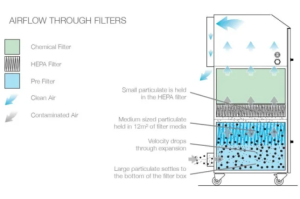
Each filter stage targets a different pollutant, so removing one stage leaves part of the problem untreated. A pre-filter traps large particles, activated carbon adsorbs gas-phase VOCs and odors, and a HEPA filter captures the finest particles.
A typical print-room stack works in this order:
- Pre-filter: catches coarse ink mist and paper dust, protecting the later stages
- Activated carbon: adsorbs solvent VOCs and odor
- HEPA filtration: captures fine particles down to 0.3 μm.
How Do You Confirm Your Exhaust System Works?
Test the system against measurable targets, not just by feel, because a hood can look active while still failing to capture fumes. Check capture velocity at the source, airflow through the ducts, and filter condition on a set schedule.
A practical verification routine includes these checks:
- Measure capture velocity at the fume source and confirm it meets your design target
- Check duct velocity to make sure ink mist and dust are not settling inside
- Track filter loading, since clogged filters cut airflow and suction
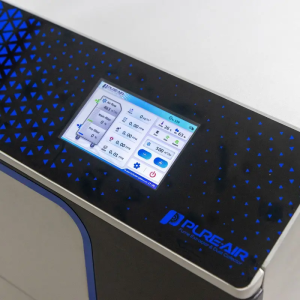
- Watch live VOC and PM2.5 readings where the equipment provides them
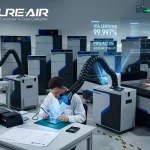
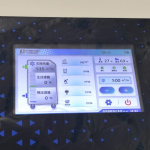
Smart monitoring makes this easier. When a unit shows VOC and PM2.5 values on screen and sends filter-life alerts, staff can act before air quality slips, instead of finding out during an inspection.
How PURE AIR Handles Exhaust in Printing Rooms?
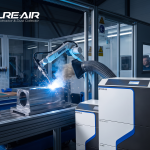
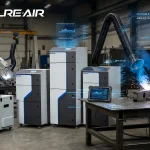
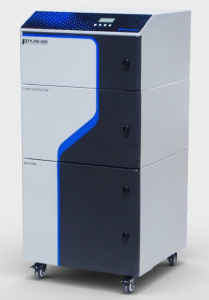
At PURE AIR, we design printing fume extractors around the same capture-then-filter logic, using triple-stage filtration and adaptive suction built for print environments. For printing rooms, our FS and FS-i Series combine triple-stage filtration with smart monitoring system.
This system uses a pre-filter, HEPA filtration for particles down to 0.3 μm, and activated carbon to help reduce odors and harmful gases. FS-i models add real-time airflow monitoring and filter alerts for easier maintenance and more consistent fume extraction.
| Model | Airflow | Pressure |
| PA-FS300 | 300 m³/hr | 3,700 Pa |
| PA-FS500 / 500i | 500 m³/hr | 10,000 Pa |
| PA-FS800 / 800i | 800 m³/hr | 10,000 Pa |
| PA-FS1600 / 1600i | 1,600 m³/hr | 10,000 Pa |
Every unit uses the same filter sequence: an F9 pre-filter, a treated carbon layer, and an H14 main filter that captures 99.99% of particles at 0.3 microns. The high negative pressure system and large-capacity filters deliver consistent airflow and reliable purification through continuous production cycles.

Need a Custom VOC Extraction Solution?
There is no single exhaust configuration that fits every printing room. The right system depends on the contaminants being generated, where they are released, the required capture points, the available airflow and pressure, and the filtration needed for the specific application.
At PURE AIR, we help printing operations connect these factors into a complete fume-extraction system, from source capture and airflow selection to multi-stage filtration and performance monitoring. If you need help designing a system for your specific printing processes, contact us for a tailored exhaust and filtration solution based on your application requirements.