Inside the Powerhouse: Why High Negative Pressure Fans Decide Fume Extractor Performance
Introduction
In our previous guide on how to choose industrial fume extractor systems, we discussed the dangerous traps of focusing solely on nominal “air volume” while ignoring the critical counterforce: system resistance and pressure drop. Today, we go deep inside the powerhouse of industrial air filtration to examine the single component that dictates whether your system actually captures toxic smoke or simply makes noise—the high negative pressure fan.
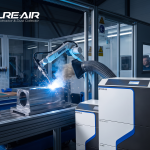
Whether you are operating high-precision fiber laser cutting machines, CNC routing systems, or automated electronics soldering lines, understanding the mechanical physics of air pressure is key to preventing hazardous smoke leakage in your workshop.
The Physics of Extraction: Air Volume vs. Static Pressure
To understand why standard commercial blowers fail in industrial applications, we must look at the physical relationship between flow and resistance. In a fume extraction circuit, airflow Q (measured in m³/h) and static pressure Ps (measured in Pascals, Pa) are governed by the system resistance curve:
Where ΔP represents the total pressure drop (resistance) and k is the system friction coefficient determined by your suction hoods, duct length, bends, and—most importantly—the progressive clogging of your filter media.
As dust particles deposit on the surface of a HEPA or cartridge filter, the pore size shrinks, rapidly increasing the resistance coefficient k. If your fume extractor is equipped with a cheap, low-pressure fan, the operating point on the fan curve will shift dramatically. The result? A massive, sudden drop in suction airflow, allowing toxic sub-micron particulates to escape directly into the breathing zone of your workers.
Why Standard Off-the-Shelf Fans Fail
Many trading companies and low-cost assemblers utilize standard commercial ventilation fans. These fans are designed for “free-blowing” applications with very low static pressure (typically under 800 Pa). While they boast impressive maximum air volume ratings on paper, their suction drops to near zero the moment they are connected to dense, multi-stage HEPA filters and carbon beds.
An industrial-grade high negative pressure fan, by contrast, is engineered with aerodynamic backward-curved impellers. This specific structural design allows the blower to generate massive static pressure (often exceeding 2,000 to 5,000 Pa). This immense pressure provides the kinetic energy required to pull air through highly dense, flame-retardant filter cartridges even when they are heavily loaded with microscopic dust.
The True Cost of Inadequate Suction
Relying on an extractor with weak static pressure damages more than just factory air quality; it hurts your manufacturing bottom line:
Shortened Filter Lifespan: Without high negative pressure to pull air through partially loaded filters, you are forced to discard expensive HEPA cartridges prematurely, often when they still have 60% of their physical dust-holding capacity remaining.
Laser Lens Contamination: In fiber laser cutting machines, weak extraction pressure allows highly reflective metal dust to settle back onto the protective mirror. This leads to cracked optical lenses, reduced laser cutting precision, and thousands of dollars in replacement costs.
Inefficient Source Capture: Hot thermal fumes rise rapidly due to thermal buoyancy. A weak suction system cannot overcome this draft, allowing hazardous metal fumes (such as hexavalent chromium and manganese) to disperse throughout your facility.
How PURE-AIR Redefines High Negative Pressure Technology
At PURE-AIR, we recognized 15 years ago that outsourced blowers could not meet the extreme reliability demands of heavy-duty metal fabrication and CNC processing workshops. That is why we established our own dedicated motor research and fan assembly lines.
1. In-House Aerodynamic Design
Our self-developed impellers undergo precise dynamic balancing testing (to ISO 1940 G2.5 standards). This high-precision balancing minimizes mechanical vibration and shaft wear, ensuring our high negative pressure fans can run continuously 24/7 with zero maintenance overhead.
2. Seamless Integration with PIPS
A high-pressure fan must be smart. PURE-AIR blowers are fully integrated with our proprietary PIPS (Pure-Air Intelligent Purification System). PIPS actively monitors static pressure across the filters. When pressure drops too low due to dust accumulation, the system automatically adjusts the fan’s variable frequency drive (VFD) to maintain constant, stable airflow at the suction point while triggering the automated pulse-jet self-cleaning sequence.
3. Heavy-Duty Sound Isolation
High negative pressure usually comes with noise. However, PURE-AIR structures utilize integrated acoustic mufflers and dual-layered sound-absorbing materials. This ensures our high-suction systems operate comfortably under 65 dB(A), maintaining a quiet, professional factory environment.
Conclusion: Power Your Factory with Pure Suction
When choosing an industrial fume extractor, never let nominal air volume mislead you. The true indicator of a system’s field performance is its high negative pressure fan. By partnering with a manufacturer like PURE-AIR, who controls the core technology and dynamically balances every blower in-house, you guarantee your workshop stable airflow, longer filter life, and absolute safety.
Optimize your factory’s extraction performance today. Contact the PURE-AIR engineering team for a customized static pressure calculation and system layout designed specifically for your machinery and production volume.