How to Evaluate Effectiveness of Fume Extraction System?
Industrial processes such as laser marking, welding, soldering, and 3D printing release fine particulates, volatile organic compounds (VOCs), and toxic gases that can damage worker health and compromise equipment precision. A dust fume extractor system is the primary engineering control that keeps these contaminants out of operators’ breathing zones. But not every system performs to specification — and a unit that looks adequate on a datasheet can still leave workers exposed if it is poorly matched to the process.
This guide outlines the technical and operational criteria that determine whether a fume extraction system is actually doing its job, with reference to OSHA, NIOSH, and ACGIH benchmarks.
Filtration Efficiency
The most important performance indicator is the percentage of contaminants the system can physically remove from the airstream. Laser and welding fumes contain ultrafine particles that are extremely easy to inhale — metal particles in weld fumes are 50 to 75 times smaller than a human hair, and most welding fume particles measure below 1 µm. Systems rated only for coarse dust will let these through.
A compliant industrial dust fume extractor system should use a multi-stage design:
- A pre-filter (F5 or F9) to capture larger debris and extend the life of downstream media
- A HEPA H13 or H14 main filter, capturing 99.95–99.99% of particles at 0.3 µm
- An activated carbon layer to adsorb VOCs, odors, and chemical vapors
For reference, PURE-AIR’s Laser Marking & Coding Fume Extractor uses an F9 accordion pre-filter (95% efficiency at 1.0 µm), an H14 deep-pleat HEPA filter (99.99% at 0.3 µm), and 12–30 kg of treated activated carbon. This three-stage configuration is what buyers should consider the minimum baseline for precision laser applications.
Airflow and Static Pressure
Filtration efficiency is meaningless if the system cannot pull contaminated air into the hood in the first place. Two specifications govern this:
- Airflow (m³/h or CFM) — the volume of air moved per unit time
- Static pressure (Pa) — the suction force that overcomes duct resistance and filter loading
ACGIH’s Industrial Ventilation Manual recommends roughly 2,000 CFM per welder in confined spaces under 10,000 cubic feet. For laser marking and coding lines, requirements vary widely — from compact single-station benchtop operations to multi-station production lines — which means the system must be sized to the application.
PURE-AIR addresses this with a graduated model range: the PA-F250s at 250 m³/h and 2,800 Pa for benchtop use, scaling up through the PA-DS series to the PA-DS2400 at 2,400 m³/h and 10,000 Pa for continuous production lines. The DS-i series adds Vortex Boost technology that reaches 10 kPa suction within three seconds, allowing the system to respond instantly to fume bursts rather than operating at constant high power.
Capture Velocity at the Source
A dust fume extractor system’s effectiveness depends on the air velocity measured at the point of contaminant release — not at the hood face. ACGIH guidelines specify capture velocities of 100–200 fpm for low-velocity contaminants released into moderately still air (such as welding) and 200–500 fpm for processes where fumes are released with some initial velocity.
A published field study of portable LEV units found capture velocities of 300, 220, and 50 fpm across three configurations, and only the higher-velocity units produced statistically significant reductions in worker exposure to total fume and hexavalent chromium. The practical takeaway: measure capture velocity with a velometer at the actual work point and confirm the hood is positioned no more than 45 cm from the emission source.
PURE-AIR‘s DS standard series offers a 10-speed LCD-controlled adjustment, while the DS-i advanced series adds dynamic airflow compensation that automatically adjusts suction as filters load — holding capture velocity constant throughout the filter lifecycle rather than letting it decay.
Noise Level and Operator Comfort
Noise is often treated as a comfort issue, but it is actually a compliance and productivity metric. A dust fume extractor system contributes to the cumulative noise load in the workspace alongside the laser machine, compressors, and ambient production noise. So, when evaluating noise performance, look at four factors:
- Rated noise level at typical operating speed, not just the minimum setting. Datasheets sometimes list the quietest mode; always confirm the value at the airflow your process actually requires.
- Noise scaling across the model range. Larger-capacity units inevitably run louder, but the increase should be gradual. A 2,400 m³/h industrial unit running below 70 dBA indicates well-engineered fan aerodynamics and acoustic damping.
- Motor type. Brushless DC motors run significantly quieter than brushed equivalents and maintain acoustic performance over their full-service life, while cheaper motors become audibly louder as bearings wear.
- Vibration and structural noise. Heavy-gauge cabinet construction and proper isolation mounts prevent the chassis itself from amplifying fan noise.
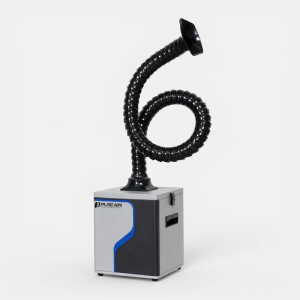
PURE-AIR’s range illustrates this scaling. Our largest PA-DS2400 fume extractor at 2,400 m³/h remains under 68 dBA. This is made possible by 20,000-hour brushless motors and powder-coated mild steel or brushed stainless steel cabinets that damp structural vibration.
Smart Monitoring and Maintenance Economics
A fume extraction system’s performance is not static. Filters load progressively, motors degrade, and airflow drops as resistance builds — all invisibly, unless the system is instrumented to report its own condition. Performance degradation that goes undetected is the single most common reason facilities fail air-quality audits despite having “adequate” equipment on paper.
When evaluating the monitoring and maintenance capabilities of a system, assess 5 elements:
- Real-time performance feedback. The system should display current airflow, static pressure, and filter loading on a local panel. Units that only show on/off status leave operators blind to gradual degradation.
- Filter-life indicators and alerts. Differential pressure sensors across each filter stage detect loading before capture velocity drops below the safe threshold, triggering alerts rather than relying on scheduled replacement.
- Remote connectivity. IoT or PLC integration allows EHS managers to monitor multiple units across a facility from a single dashboard — critical when systems are distributed across several production lines.
- Predictive maintenance. Algorithms that forecast filter replacement windows and motor service intervals based on actual usage data reduce both unplanned downtime and premature replacement of still-serviceable consumables.
- Firmware and software updates. Remote upgrade capability ensures the system’s logic can be improved over its service life without technician site visits.
These capabilities are available in PURE-AIR’s DS-i series, which provides an industrial touchscreen with IoT connectivity, real-time performance tracking, predictive filter maintenance, dynamic airflow compensation, and remote firmware upgrades — allowing the system to operate unattended across shifts while providing EHS managers with continuous visibility into air-quality performance.

Conclusion
The real test of a dust fume extraction system is not whether it runs, but whether it still holds the breathing zone below exposure limits on the three-hundredth day of operation. This is why evaluation should never be a one-time procurement exercise. The criteria discussed here are also the criteria by which a system should be re-validated annually, because compliance is a moving target that depends on how the system is used, maintained, and monitored over time.
The practical implication for facility managers is that specification alone is not a guarantee of safety — the system architecture must make good performance easy to maintain and poor performance impossible to ignore. That is the gap between a fume extractor that protects workers for a year and one that protects them for a decade.
PURE-AIR’s Laser Marking & Coding Fume Extractor range is built around this principle, combining HEPA H14 filtration, application-matched airflow, and intelligent monitoring across the F, DS, and DS-i series for manufacturing production environments.
To discuss the right configuration for your process or request a technical consultation, contact the PURE-AIR today!