Why Are Particulate Removal Systems Required for 3C Product Manufacturing?
The 3C manufacturing sector, which encompasses computers, communications, and consumer electronics, operates under some of the most stringent production standards in the modern industrial world. As microchips shrink and circuit boards become more densely packed, the environments in which these components are assembled must remain pristine. During high-speed automated assembly, laser marking, soldering, and mechanical cutting, massive amounts of microscopic dust, hazardous smoke, and volatile chemical vapors are generated. Without dedicated intervention, these airborne contaminants compromise product integrity, threaten operational efficiency, and damage expensive infrastructure. Implementing robust fume extraction technology from trusted industry leaders like PURE AIR is no longer a luxury but an absolute operational necessity for B2B manufacturers worldwide seeking to maintain environmental compliance.
The Precision Vulnerability of Consumer Electronics
Consumer electronics depend on flawless micro-connections and pristine surfaces to function reliably, making them highly vulnerable to sub-micron particles invisible to the human eye. In 3C manufacturing, printed circuit boards (PCBs) feature micro-vias and conductive traces spaced only micrometers apart. When airborne dust or metallic particulates settle on these unpopulated boards during assembly, they create unintended conductive paths that lead to electrical shorts, signal degradation, or immediate component failure during quality testing. By implementing advanced air filtration and targeted fume extraction technology, manufacturers reduce these invisible threats, keeping electrical pathways clear and ensuring signal integrity across high-frequency communication devices.
Beyond circuitry, modern smartphones and wearable devices rely heavily on complex camera modules, facial recognition sensors, and optical displays that demand flawless cleanroom conditions. During the housing assembly and gluing processes, floating particles can easily trap themselves inside camera lenses or sensor housings, causing permanent dark spots on image sensors and leading to immediate product rejection. Maintaining a particulate-free environment through continuous fume extraction technology preserves the strict cosmetic and functional standards required for high-end consumer optics, ensuring that advanced devices achieve the flawless visual performance consumers expect.
Maximizing Production Yields and Profit Margins
In the highly competitive 3C market, profit margins are closely tied to first-pass yield rates, meaning that industrial waste caused by contamination directly erodes a manufacturer’s bottom line. Automated pick-and-place machines operate at blistering speeds, relying on vacuum nozzles to position tiny surface-mount components precisely. Airborne dust can clog these precise nozzles, causing component misalignments, dropped parts, or missing joints. Dedicated particulate capture systems and automated fume extraction technology continuously clean the micro-environments around these machines, reducing automated assembly errors, slashing scrap rates, and substantially improving overall production yields.
Furthermore, when dust contaminates a specific batch of solder paste or liquid adhesive, the defect repeats across hundreds of consecutive units before automated optical inspection systems can detect the issue. The rework required to desolder and fix these contaminated components is incredibly labor-intensive and costly, often delaying shipping schedules. Consistent airflow purification and localized fume extraction technology prevent widespread batch contamination entirely, ensuring that automated assembly lines maintain uniform quality from the start of a shift to the end without costly manual intervention.
Extending the Lifespan of Expensive Production Machinery
The manufacturing equipment used in 3C production represents a massive capital investment, making asset protection vital for long-term profitability. The robotic arms and linear actuators used in electronics assembly rely on smooth, lubricated guide rails and precise bearings to function. Airborne particulate matter mixes with industrial lubricants over time, turning into an abrasive paste that accelerates mechanical wear and causes positioning drift that reduces the accuracy of the robotics. Integrating high-performance fume extraction technology captures these abrasive particles at the source, preventing them from settling on moving parts and keeping machinery operating at peak calibration.
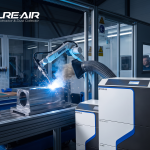
Similarly, laser engraving, cutting, and welding processes generate dense, sticky smoke containing fine carbon and metal particles that threaten sensitive optical lenses. If this smoke migrates onto the laser’s protective lens, the intense heat bakes the residue onto the glass, causing thermal distortion or cracking the expensive optical lens. Utilizing specialized fume extraction technology draws these harmful sub-micron particles away from the laser head, keeping the optics clean, reducing equipment downtime, and extending the operational lifespan of the laser equipment.
Enhancing Workplace Safety and Legal Compliance
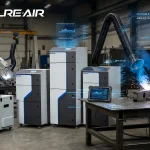
Industrial air quality directly impacts employee retention, workplace morale, and adherence to shifting environmental and occupational safety regulations. Soldering processes release complex chemical fumes containing rosin core decomposition products, lead micro-particles, and synthetic fluxes. Prolonged exposure to these airborne toxins can trigger occupational asthma, severe eye irritation, and long-term respiratory illness among assembly line workers. Relying on high-efficiency fume extraction technology captures these dangerous emissions directly at the workstation before they enter the breathing zone of operators, ensuring a healthy, comfortable, and productive work environment.
In addition to health risks, environmental agencies worldwide have established strict threshold limit values for indoor air quality and factory emissions. Facilities that fail to control their particulate emissions face severe financial penalties, mandatory operational shutdowns, and long-term reputational damage. By choosing advanced systems developed by PURE AIR, facilities guarantee that clean, purified air is safely recirculated or exhausted, keeping the manufacturing facility fully compliant with all regional environmental legislation and building trust with international buyers.
The Role of PURE AIR in Modern Electronics Manufacturing
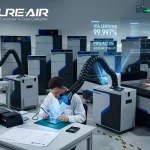
To tackle the multifaceted challenges of 3C production, electronics manufacturers require dependable, high-efficiency filtration hardware tailored for industrial demands. Standard ventilation systems lack the specialized capability required to filter out microscopic industrial debris. Advanced extraction units utilize multi-stage filtration systems, combining structural pre-filters, carbon gas phases, and certified HEPA media. This specific engineering allows the equipment to capture up to 99.97% of airborne particles down to 0.3 micrometers, ensuring the air within the manufacturing zone remains thoroughly purified and fulfilling both product quality and employee safety mandates simultaneously.
Every manufacturing facility operates with unique spatial constraints, machinery layouts, and production volumes, meaning that selecting the ideal equipment requires careful evaluation of airflow rates, pressure levels, and the specific chemical composition of the generated fumes. For factories seeking to optimize their air quality strategy, the team at PURE AIR provides robust, field-tested systems engineered for rapid integration into automated assembly lines.
To explore how customized extraction solutions can enhance your manufacturing yield and protect your workforce, contact us today for an expert consultation.